
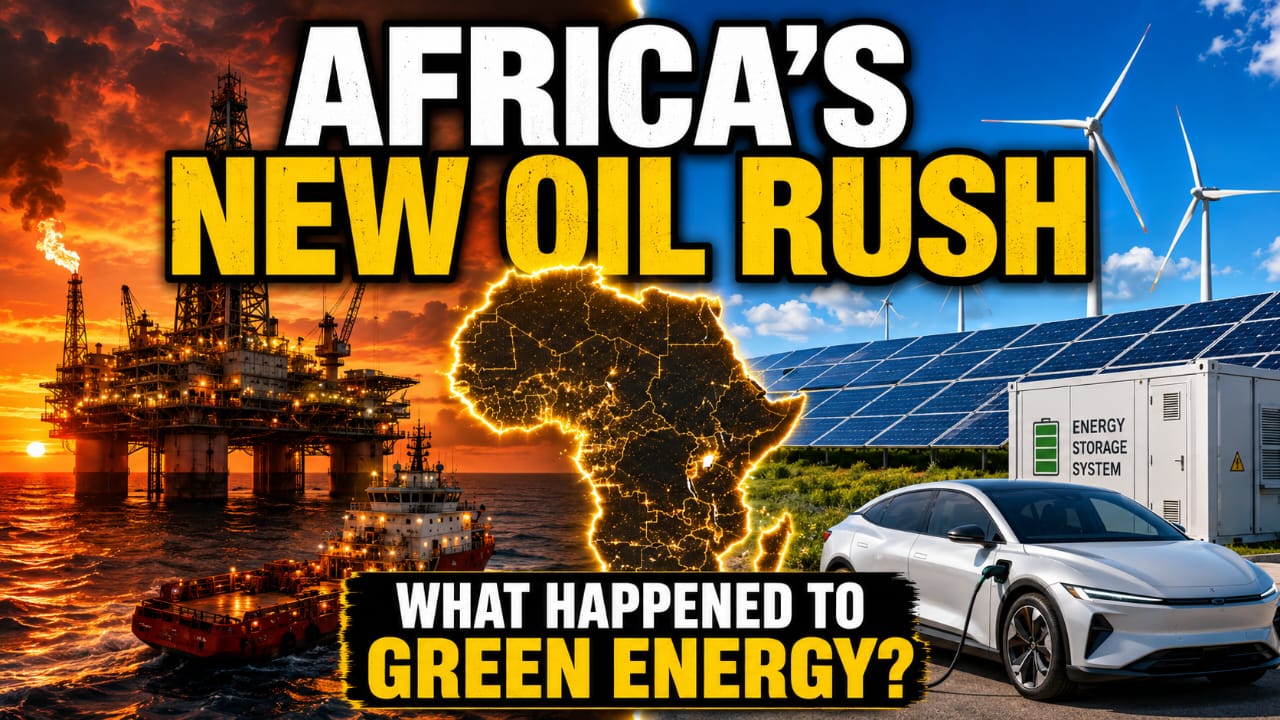
From Mauritania and Senegal to Angola, Namibia and South Africa, global energy companies are searching for the next great offshore petroleum province. But the renewed rush raises a difficult question: will Africa’s new oil discoveries finance its development and energy transition—or repeat an old history of extraction without transformation?
At a time when governments, investors and environmental organisations are urging the world to reduce its dependence on fossil fuels, some of the largest international oil companies are moving aggressively in another direction.
They are returning to the Atlantic coast of Africa.
Chevron, Shell, TotalEnergies and other major operators are acquiring offshore exploration interests from West Africa to the southern end of the continent. Their attention stretches from Mauritania, Senegal and Guinea-Bissau through Nigeria and Angola, and further south towards Namibia and South Africa.
The scale of the renewed interest suggests that the petroleum age is far from over.
It also creates one of the most important energy questions facing Africa today: why are oil companies committing billions of dollars to new exploration when solar power, wind generation, battery storage and electric vehicles are expanding so rapidly?
The answer lies in geology, economics and sharply different expectations about the future of global energy.
Searching Africa for the Next Brazil
One of the strongest forces behind the latest exploration drive is the geological relationship between Africa and South America.
Millions of years ago, the two continents formed part of the same landmass. Their later separation created the Atlantic Ocean, leaving related geological formations on opposite sides of the water.
Brazil subsequently became one of the world’s most successful offshore oil provinces. Its giant deep-water discoveries encouraged geologists and petroleum companies to examine the western coast of Africa for corresponding formations.
The two sides of the Atlantic are sometimes described by oil explorers as geological twins.
The theory is straightforward: if enormous oil-bearing structures developed beneath Brazil’s offshore waters, comparable structures may also exist beneath the Atlantic margin of Africa.
The success of exploration in Namibia has strengthened that belief.
New discoveries have turned the country into one of the world’s most closely watched petroleum frontiers. Interest has also increased in Côte d’Ivoire, Angola, South Africa and other parts of the Atlantic coastline.
According to industry estimates cited by Reuters, approximately 8.7 billion barrels of oil equivalent have been discovered along West Africa since 2020. The region accounted for about 11 per cent of global oil and gas discoveries during that period and roughly 14 per cent of newly discovered liquid petroleum resources.
Namibia alone is estimated to possess more than six billion barrels of discovered and potentially recoverable oil equivalent.
The figures do not guarantee commercial success. Oil in the ground is not the same as oil that can be produced profitably. Nevertheless, the discoveries have been large enough to attract the attention of the world’s most powerful energy companies.
They are searching, in effect, for the next Brazil.
Why the Oil Companies Need New Frontiers
Oil companies face a permanent commercial challenge: every barrel they produce reduces their existing reserves.
To remain major petroleum businesses, they must continually replace what they extract.
Many established oilfields are ageing. Some are declining, while others are becoming more expensive to operate. American shale production remains important, but it cannot expand without limit.
This creates pressure to find new reserves capable of sustaining production through the 2030s and beyond.
Africa offers vast areas of relatively underexplored offshore territory.
Some governments are also revising taxes, licensing systems and contractual terms to attract investment. Angola, for example, has introduced reforms intended to revive exploration in mature and undeveloped areas.
Shell, which had reduced parts of its African portfolio over the years, has returned to offshore Angola after an absence of approximately two decades.
TotalEnergies has expanded its interests in several African countries, while Chevron has acquired additional acreage along the West African coast.
The companies are making a calculated wager.
They believe that even as the world expands renewable energy, petroleum will remain commercially valuable for many years.
Has the Energy Transition Been Exaggerated?
The renewed oil rush does not mean that renewable energy has failed.
Quite the opposite.
Solar power is expanding at extraordinary speed. Wind generation continues to grow. Battery prices have fallen over time, and electric vehicles are taking a larger share of new-car sales in many markets.
During 2025, almost 700 gigawatts of renewable electricity capacity were added worldwide. Renewables accounted for most of the increase in global power-generating capacity.
This is a profound transformation.
Supporters of the energy transition argue that the direction of travel is now unmistakable. As transport becomes increasingly electric, energy efficiency improves and governments strengthen climate policies, petroleum demand should eventually stop growing.
The International Energy Agency has presented scenarios in which oil demand reaches a plateau around 2030 and then gradually declines.
But a peak does not mean disappearance.
Oil remains deeply embedded in aviation, shipping, freight transport, petrochemicals, plastics, fertilisers and heavy industry. Some of these sectors are considerably more difficult to electrify than passenger cars or household power supplies.
The oil industry therefore argues that the transition will take much longer than many campaigners expect.
OPEC Sees Decades of Rising Demand
The Organisation of the Petroleum Exporting Countries presents a much more optimistic future for petroleum.
OPEC’s latest long-term outlook projects global oil demand rising to approximately 124 million barrels per day by 2050.
Its case rests heavily on population growth, urbanisation and industrial development, particularly in Africa, Asia and other emerging regions.
Billions of people are seeking improved housing, transportation, manufactured products and higher living standards. These changes require enormous quantities of energy.
The industry also points out that past energy transitions rarely involved the sudden elimination of an older source.
Coal did not disappear when oil became dominant. Oil did not vanish when natural gas expanded. New energy sources were added to an increasingly large system.
From this perspective, renewable energy may grow very rapidly without immediately removing petroleum from the market.
That is why oil companies remain willing to spend heavily on exploration.
They are not necessarily denying the rise of solar, wind and batteries. They are betting that the overall global demand for energy will become large enough to support both systems for decades.
The Danger of a Late Oil Boom
The counterargument is that large offshore developments take many years to complete.
A company may spend billions of dollars on exploration, appraisal wells, production platforms, pipelines and export facilities before producing its first commercial barrel.
By then, the market may have changed.
Electric vehicles could reduce petrol demand. Climate regulations could become stricter. Renewable power and storage could become even cheaper. Investors could become increasingly unwilling to finance long-lived fossil-fuel projects.
That creates the danger of stranded assets: fields, pipelines and related infrastructure that lose their commercial value before recovering their full costs.
This danger is especially important for African governments.
Companies can withdraw, sell assets or write down losses. Countries may be left with debt, environmental damage and infrastructure that no longer produces the expected revenue.
There is therefore a narrow window between developing a commercially valuable resource and entering the market too late.
Africa’s Right to Use Its Resources
Supporters of African petroleum development also raise a powerful question of fairness.
Europe, North America and other industrialised regions built much of their prosperity through coal, oil and gas.
African countries contributed only a small proportion of the historical carbon emissions accumulated in the atmosphere, yet they are among the most vulnerable to drought, flooding, rising temperatures and other consequences of climate change.
Why, petroleum-producing governments ask, should African nations now be told to leave valuable resources beneath the ocean?
Oil and gas revenues could finance roads, railways, ports, schools, hospitals and electricity networks.
Petroleum development could support local engineering companies, technical employment, refineries, fertiliser plants and petrochemical industries.
Natural gas could also replace expensive and polluting diesel generators while providing dependable power when solar and wind production fluctuate.
For countries facing severe energy shortages and limited public revenue, these are not abstract arguments.
They concern economic survival and the possibility of accelerated development.
Africa’s Oil History Supplies a Warning
The difficulty is that Africa has experienced petroleum booms before.
Oil exports generated billions of dollars, but the benefits were often distributed unevenly.
In several producing countries, electricity remained unreliable. Refineries deteriorated. Public infrastructure remained poor. Oil-producing communities experienced pollution, gas flaring and the destruction of fishing and farming livelihoods.
Africa exported crude petroleum and then spent scarce foreign exchange importing petrol, diesel and other refined products.
Revenue entered government accounts without producing the broad industrial transformation that had been promised.
This is why an oil discovery cannot automatically be described as an energy solution.
Crude oil extracted offshore and exported to another continent does not necessarily provide electricity to an African family.
An oil-producing country can remain energy-poor.
That contradiction remains one of the most disturbing features of Africa’s petroleum economy.
An Energy-Rich Continent Still Waiting for Electricity
Hundreds of millions of people around the world remain without access to electricity, with Sub-Saharan Africa carrying the largest part of the burden.
The region’s population is growing rapidly, but electrification is not advancing quickly enough to meet demand.
Many homes, clinics, schools and small businesses remain dependent on candles, kerosene, firewood or expensive private generators.
Africa may therefore become one of the world’s most attractive new petroleum frontiers while a large proportion of its population continues to live without reliable power.
The contradiction exposes the difference between resource production and public development.
An oilfield is valuable only to the extent that its wealth is converted into infrastructure, opportunity and improved living conditions.
Renewable Energy Offers Another Path
Africa also possesses some of the world’s strongest solar resources, significant wind corridors, major rivers and considerable potential for geothermal and hydroelectric power.
Solar mini-grids can bring electricity to communities located far from national transmission networks. Distributed renewable systems can often be installed more quickly than large centralised power projects.
Renewables can also reduce fuel imports and protect countries from volatile international petroleum prices.
But clean energy is not free from difficulty.
Solar and wind are variable. Reliable systems require transmission lines, battery storage, flexible generation and better-managed electricity networks.
Many African governments and companies also struggle to secure affordable long-term financing.
Despite its extraordinary renewable potential, Africa still attracts only a small proportion of global clean-energy investment.
The debate cannot therefore be reduced to a simple choice between oil and solar.
Africa requires dependable electricity immediately, while also preparing for a lower-carbon future.
Can Oil Finance the Green Transition?
The most practical position may be to use some petroleum resources while deliberately investing the proceeds in the industries and infrastructure of the future.
That would require a very different approach from earlier oil booms.
Contracts must be transparent. Revenue must be independently accounted for. Producing communities must receive tangible benefits.
African engineers, companies and workers must participate meaningfully rather than remaining spectators in their own resource economy.
Governments should invest in refining, petrochemicals, electricity generation and regional infrastructure instead of simply exporting another generation of unprocessed crude.
Sovereign wealth and development funds should protect part of the revenue for future generations.
Most importantly, a clearly defined portion of petroleum income could be directed into solar power, wind generation, battery storage, modern electricity grids, public transportation and technical education.
Oil would then become a bridge towards diversification rather than a permanent economic dependency.
Without those safeguards, the new rush could enrich international companies and political elites while leaving African societies almost exactly where they were.
The Real Question Facing Africa
The petroleum age is clearly not over.
Oil will remain essential to aviation, shipping, industry and petrochemical production for years to come.
At the same time, the rise of renewable energy is not an illusion. Solar, wind, battery storage and electric transportation are advancing rapidly and will capture an increasingly large part of global investment.
The two systems are likely to operate beside one another for decades.
The world’s oil companies are returning to Africa because they believe petroleum will remain profitable during that period.
But Africa must ask a different question.
Will it once again provide raw materials for the rest of the world while its own people wait for electricity, employment and public services?
Or will it use this remaining petroleum opportunity to build refineries, industries, infrastructure and a diversified energy economy?
The companies are searching Africa for the next Brazil.
Africa must decide whether it will merely supply the next great oil province—or finally convert the resources beneath its waters into development above the ground.