
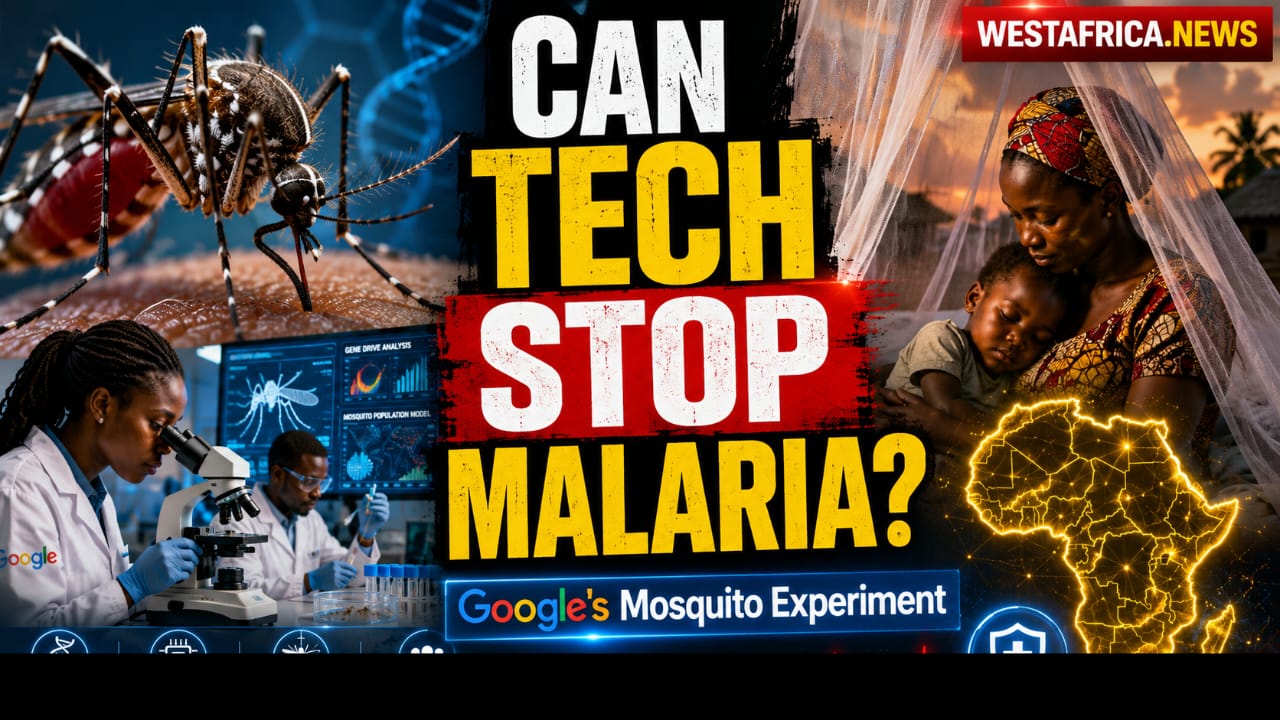
Google wants permission to release millions of specially treated male mosquitoes in parts of the United States. The insects are intended not to spread disease, but to reduce the populations of mosquitoes that do. Could the same scientific and engineering approach eventually strengthen Africa’s fight against malaria?
At first, the proposal sounds like the beginning of a science-fiction film.
Google wants to release millions of mosquitoes into the environment.
But the plan is not to increase the danger posed by mosquitoes. It is to use mosquitoes against mosquitoes.
Through its Debug project, Google has developed technology for breeding, sorting and releasing very large numbers of male mosquitoes carrying a naturally occurring bacterium known as Wolbachia.
The male mosquitoes do not bite people.
When the treated males mate with wild females that do not carry the compatible strain of Wolbachia, the resulting eggs fail to hatch.
With repeated releases, the number of disease-carrying mosquitoes in the target area is expected to fall.
Google is seeking regulatory approval to test the approach on a substantial scale in California and Florida.
The project has attracted attention because it combines biological science with automation, sensors, artificial intelligence and mass-production technology.
The question for Africa is not whether Google is about to release these mosquitoes on the continent.
It is not.
The more important question is whether this type of technology could eventually contribute to Africa’s struggle against mosquito-borne disease.
Fighting the mosquito with another mosquito
Traditional mosquito control usually relies on several familiar tools.
These include insecticide-treated bed nets, indoor spraying, environmental sanitation, drainage, larval control and the removal of stagnant water.
All remain important.
But mosquito-control programmes face growing challenges.
Some mosquito populations are developing resistance to insecticides. Rapid urbanisation has created new breeding environments. Climate change may be altering the geographical range and seasonal behaviour of mosquitoes.
Scientists are therefore looking for additional ways to reduce mosquito populations without relying entirely on chemicals.
The Wolbachia method is one of the most closely watched approaches.
Wolbachia occurs naturally in many insect species, although it is not usually present in the principal mosquito populations targeted by these programmes.
Scientists introduce the bacterium into laboratory-reared mosquitoes.
Large numbers of treated males are then released to mate with wild females. The reproductive incompatibility prevents viable offspring from being produced.
The objective is not to eliminate every mosquito.
It is to suppress a particular species strongly enough to reduce the transmission of disease.
Why only male mosquitoes are released
One of the first concerns people may have is whether releasing millions of mosquitoes will expose communities to more bites.
The answer is that the programmes are designed to release males.
Female mosquitoes require blood to support the development of their eggs. Male mosquitoes feed largely on plant nectar and do not ordinarily bite human beings.
This makes accurate sorting essential.
Google’s contribution is not simply the bacterium itself. The company is applying machine vision, sensors, automation and data analysis to the difficult task of breeding mosquitoes at scale and separating males from females.
That engineering challenge is central to the success of the project.
A mosquito-control method may work inside a laboratory but still fail as a public-health programme if it cannot produce and distribute enough insects safely, consistently and affordably.
Google’s Debug project is attempting to solve that problem of scale.
The Singapore experience
The method is not entirely new.
Singapore has used repeated releases of male Wolbachia-carrying mosquitoes as part of its campaign against dengue.
Programmes there have reported major reductions in targeted mosquito populations and lower dengue risk in areas where releases have been sustained.
That experience has helped build confidence that biological mosquito suppression can work outside the laboratory.
However, success in one country does not automatically guarantee the same results elsewhere.
Climate, mosquito species, population density, public understanding, local ecology and the capacity of health authorities can all affect the outcome.
Any African application would therefore require local research, regulatory supervision and community participation.
The malaria distinction
Google’s proposed experiment should not be presented as a direct cure for malaria.
The mosquitoes targeted by the American project are not necessarily the same species responsible for most malaria transmission in Africa.
Malaria is principally spread by female Anopheles mosquitoes.
The Google-backed programmes have largely concentrated on other mosquito species that spread illnesses such as dengue, Zika, chikungunya and West Nile virus.
This distinction matters.
A method developed for one species cannot simply be transferred to another without extensive research.
Nevertheless, the broader scientific principle may still be relevant.
Africa already has researchers investigating biological and genetic methods for controlling malaria-transmitting mosquitoes.
In August 2025, researchers in Burkina Faso released genetically modified male mosquitoes without gene-drive capability as part of a controlled malaria-research programme.
That project is separate from Google’s Wolbachia work.
But both initiatives reflect the same broad shift in public-health science: reducing disease by interfering with the mosquito’s ability to reproduce or transmit infection.
Why Africa should pay attention
Africa carries by far the largest share of the global malaria burden.
According to the World Health Organization, the African Region accounted for roughly 95 per cent of malaria cases and deaths in 2024.
Hundreds of millions of infections were recorded, and most malaria deaths occurred on the continent.
Young children continue to carry a particularly heavy burden.
These figures explain why every scientifically credible new tool deserves serious African attention.
But attention should not mean blind acceptance.
African countries must ask practical questions.
Can the technology be adapted to the mosquito species that spread malaria locally?
Can African laboratories and universities participate in its development?
Can mosquito-production facilities be established and operated on the continent?
What would the programme cost?
Would communities understand and accept the deliberate release of mosquitoes?
What monitoring systems would be required?
Who would control the technology and the resulting data?
These questions are as important as the science itself.
Public trust cannot be an afterthought
A programme that releases mosquitoes into communities is likely to produce anxiety.
Even when the insects are non-biting males, many people will instinctively associate them with disease.
That is why public communication must begin before any release takes place.
Residents need clear information about the species involved, how the mosquitoes are treated, why males are selected, what risks have been studied and how the programme will be monitored.
Community leaders, health workers, journalists, scientists and local authorities must be involved.
Public consent should not be treated as a public-relations exercise after the scientific decisions have already been made.
It should be part of the research process.
Africa has experienced public-health interventions in which local communities felt decisions were imposed from outside.
Any future mosquito-release programme must avoid repeating that pattern.
Not a replacement for existing malaria tools
There is a danger that dramatic technology can make established public-health measures appear old-fashioned.
That would be a serious mistake.
Even if biological mosquito suppression proves successful, Africa will still need insecticide-treated nets, effective medicines, rapid diagnosis, indoor spraying, environmental management and vaccination.
The World Health Organization has now recommended malaria vaccines for use in children in areas of moderate and high transmission.
Vaccines can reduce severe illness and deaths, but they do not remove the need for mosquito control.
Nor can mosquito control replace access to diagnosis and treatment.
Africa requires a combined strategy.
The Google experiment should therefore be viewed as a possible additional tool — not a miraculous substitute for everything already known to work.
Africa must become a scientific partner
The larger lesson may go beyond mosquitoes.
Too often, Africa enters the story of new technology only as the place where the problem is greatest or where a product may eventually be deployed.
That is not enough.
African scientists, research institutes, public-health agencies and technology companies should be involved in designing the next generation of mosquito-control systems.
Local institutions understand local mosquito species, environments, disease patterns and community concerns.
They should not merely receive finished technologies developed elsewhere.
They should help create, test, regulate and own them.
This would also prevent long-term dependence on foreign suppliers for mosquito strains, specialised machinery, technical maintenance and data analysis.
The real opportunity is not simply for Google or another outside organisation to bring mosquito technology to Africa.
It is for African institutions to build comparable capacity.
The promise and the caution
Google’s proposal is bold.
It also raises legitimate questions about ecological effects, accidental release of females, long-term effectiveness and the possibility that mosquito populations may eventually adapt.
The technique is species-specific, which reduces some ecological risks, but continued monitoring remains essential.
Regulators must be satisfied that releases are carefully controlled and that unexpected effects can be detected early.
The public also deserves transparency about results, failures and costs.
Scientific enthusiasm should never replace public accountability.
At the same time, fear should not prevent serious investigation of a technology that could save lives.
Mosquito-borne diseases remain among the world’s most persistent public-health threats.
Africa has more reason than any other region to explore new solutions.
A total approach to malaria
Google’s mosquito experiment will not by itself solve Africa’s malaria crisis.
It may not even be directly transferable to malaria-transmitting mosquitoes in its present form.
But it demonstrates what becomes possible when biology, engineering, artificial intelligence and public health are brought together.
Africa should follow the experiment closely.
It should study the results.
It should support its own mosquito research.
And it should insist on a total approach combining vaccines, treated nets, insecticides, environmental sanitation, diagnosis, treatment and carefully tested new technologies.
The mosquito has adapted repeatedly to humanity’s attempts to defeat it.
Africa’s response must therefore be equally adaptive.
The question is not whether one experiment will eliminate malaria.
The question is whether Africa can turn every credible scientific advance into part of a coordinated campaign against one of its oldest and deadliest enemies.