
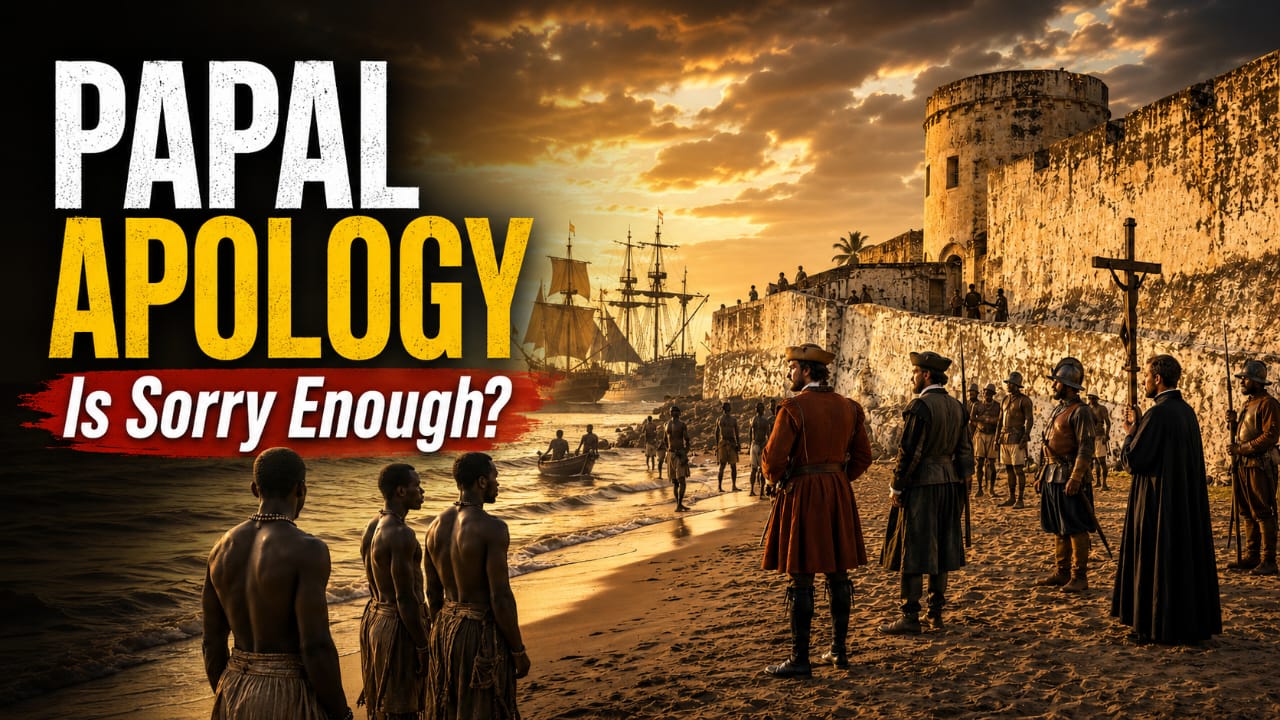
In 1452, a papal document gave Portugal religious authority to conquer and enslave non-Christian peoples. In 2026, Pope Leo XIV asked pardon for the Holy See’s role in legitimising slavery. For Africa, the apology opens an important question: what should come after the words?
More than five centuries separate two remarkable moments in the history of the Roman Catholic Church.
On 18 June 1452, Pope Nicholas V issued a papal bull known as Dum Diversas. Addressed to King Afonso V of Portugal, the document authorised the Portuguese crown to attack, conquer and subjugate designated non-Christian peoples and reduce them to perpetual servitude.
On 25 May 2026, Pope Leo XIV issued what has been described as the Vatican’s most direct apology for the Holy See’s historical role in legitimising slavery.
Between those two moments lie 574 years of conquest, forced migration, colonial expansion, racial domination and unfinished historical memory.
For Africa and its diaspora, the apology is therefore more than an internal matter for the Catholic Church. It enters directly into the growing global debate about slavery, colonialism, historical responsibility and reparative justice.
A document with consequences beyond Rome
Dum Diversas emerged as Portugal expanded its activities along the West African coast.
The language of the document belonged to a period in which European monarchies, military expansion and religious authority were closely connected. But its consequences were neither confined to theology nor limited to the fifteenth century.
The papal bull provided Portugal with a form of moral and religious authority for conquest and enslavement. A later document issued by Pope Nicholas V, Romanus Pontifex in 1455, strengthened Portuguese claims over territories, trade routes and peoples encountered during its expansion.
Together with other colonial-era papal documents, these declarations became associated with what later came to be called the Doctrine of Discovery: a framework used by European Christian powers to claim lands occupied by non-Christian peoples.
Although historians continue to debate the precise legal and theological relationship between these documents and the later transatlantic slave trade, their role in providing religious justification for conquest and servitude remains deeply significant.
For West Africa, this was not merely an argument between rulers and clergy in distant European courts.
It became ships along the coast.
It became forts and holding cells.
It became commercial networks built around the forced movement of human beings.
It became families separated and communities destabilised.
It became part of the ideological machinery through which domination was presented as legitimate.
Pope Leo asks pardon
Pope Leo XIV’s apology represents an unusually direct acknowledgment of the Holy See’s own institutional record.
In his first encyclical, Magnifica Humanitas, the pope acknowledged that Church authority had helped regulate and legitimise forms of enslavement, particularly those imposed on people classified as non-Christian.
He also recognised that the Church’s universal and unequivocal condemnation of slavery came painfully late.
The pope expressed deep sorrow, asked pardon and described the historical record as a wound in Christian memory.
This goes beyond saying that some individual Christians participated in slavery.
It acknowledges that Church institutions and papal authority contributed to the moral environment in which conquest and human bondage could be justified.
Earlier popes condemned slavery, colonial abuses and the mistreatment of Indigenous peoples. In 2023, the Vatican formally repudiated the Doctrine of Discovery and acknowledged that colonial powers had manipulated papal documents to justify immoral acts.
However, campaigners and scholars continued to argue that the Vatican had not fully confronted the authority those documents gave to European expansion.
Pope Leo’s statement places that institutional responsibility more clearly at the centre of the conversation.
Why the apology matters to Africa
The apology comes at a time when African countries, Caribbean governments and communities throughout the African diaspora are intensifying calls for historical accountability.
European governments are being asked to confront their roles in slavery and colonialism.
Museums are being pressed to return cultural objects acquired through conquest or questionable colonial transactions.
Universities, banks, churches and commercial institutions are investigating their historical links to slave ownership and colonial extraction.
The Vatican cannot be separated from this wider reckoning.
Christianity was sometimes used to resist slavery and defend the oppressed. Clergy and religious communities also played important roles in education, liberation struggles and campaigns against racial injustice.
But Christianity was also used to give sacred language to empire.
That contradiction must form part of any honest account of the past.
Pope Leo’s apology matters because it removes some of the distance between the institution and the injury. It recognises that the Church was not always merely an observer of oppression. At critical moments, its authority helped to create the moral conditions in which oppression could flourish.
Is an apology enough?
An apology can be historically important without being historically sufficient.
The next question is therefore unavoidable: what should follow?
For Africa and the diaspora, meaningful action could include opening additional Vatican archives to researchers, supporting independent historical investigations and making relevant documents more accessible to the public.
Catholic schools, universities and seminaries could teach the history of the papal bulls, colonial conquest and slavery with greater clarity.
The Vatican could work with African scholars, museums, churches and cultural institutions to support memorial projects, archives and educational programmes.
There will also be demands for restitution and reparative justice.
These need not be reduced to the simplistic idea of writing a single cheque for the crimes of history. Reparative action can include investment in education, heritage preservation, historical research, community development and the recovery of cultural memory.
The essential principle is that apology should have consequence.
Without action, even sincere words risk becoming a ceremonial conclusion to a history whose effects remain visible.
The past has not disappeared
Some may argue that events from the fifteenth century are too distant to remain politically relevant.
But history does not vanish merely because those who initiated it are gone.
The Atlantic slave trade changed Africa’s population, economies and political development. Colonial rule followed centuries of European commercial expansion. Racial hierarchies created during these periods continued long after formal slavery and colonial administration ended.
The global inequalities of the present cannot be attributed to one document or one institution.
But neither can they be understood without confronting the systems of thought, law, commerce and religion that helped to establish them.
That is why Dum Diversas still matters.
It demonstrates how institutions can transform domination into policy and present conquest as moral duty.
From confession to repair
The Vatican’s 574-year reckoning is not solely a Catholic story.
It is a story about the relationship between faith and power.
It is about the ability of respected institutions to admit that their authority was once used to justify injustice.
It is also about whether confession can become a foundation for repair.
In 1452, a pope gave religious authority to conquest and servitude.
In 2026, another pope asked pardon.
The apology deserves recognition. It represents an important act of historical honesty.
But Africa should not receive it passively.
The continent and its diaspora should ask what records will be opened, what history will be taught, what partnerships will be created and what practical forms of repair will follow.
An apology cannot undo centuries of human suffering.
It can, however, mark the moment when silence gives way to truth.
The deeper test is whether truth will now give way to action.