
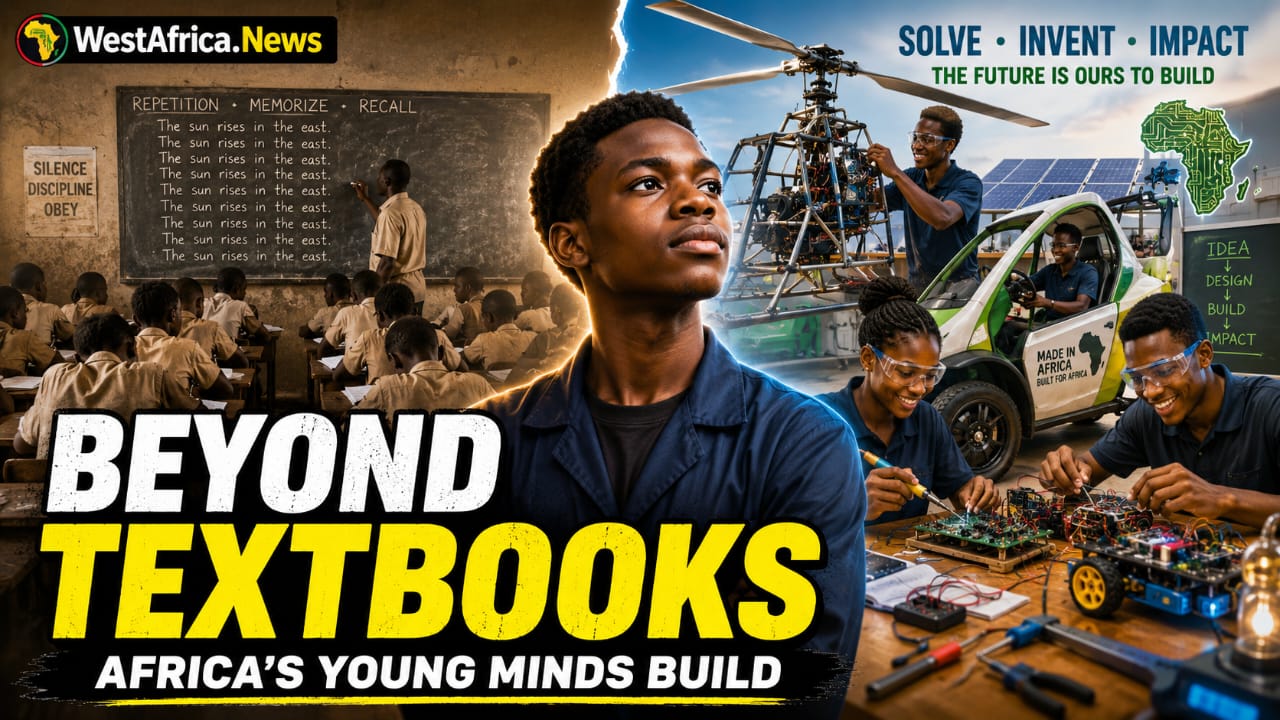
For generations, education across much of Africa has been criticised for producing students who can recite, memorise and pass examinations, but are often not sufficiently trained to build, repair, design or manufacture.
The criticism is not new. Many have traced the problem partly to colonial education, which was largely designed to produce clerks, interpreters, teachers and junior administrators for the colonial system—not inventors, industrialists, engineers or manufacturers.
Decades after independence, much of that inheritance still lingers. Across West Africa, students may study physics without building machines, agriculture without managing farms, and engineering without enough access to serious workshops.
But a different story is also beginning to emerge.
Across the region, young Africans are asking a more practical question. Not simply: “What have I learnt?” But: “What can I build with what I have learnt?”
The Helicopter That Raised a Question
In 2007, Mubarak Muhammad Abdullahi, then a young physics undergraduate at Bayero University in Kano, Nigeria, attracted international attention after building a homemade helicopter from discarded vehicle and aircraft parts.
The machine reportedly used components from old cars, motorbikes and even parts associated with a damaged aircraft. It was not a commercial aircraft. It was not ready for regular flight. But it reportedly lifted a few feet above the ground.
That brief rise carried a larger message.
Africa’s young people do not lack imagination. The unresolved question is whether Africa’s schools, universities, governments and industries are ready to rise with them.
Kelvin Doe: From Scrap Electronics to Community Radio
In Sierra Leone, Kelvin Doe became known for building batteries, generators, transmitters and a small community radio station from discarded electronic parts.
As a teenager, he did not wait for a fully equipped laboratory. He searched through waste, taught himself electronics and built what his community needed. His work eventually attracted international attention and took him as far as the Massachusetts Institute of Technology in the United States.
But his achievement also raises an uncomfortable question.
Why should African genius have to emerge from refuse before it is recognised?
What would happen if children like Kelvin Doe were identified early, equipped properly and supported through structured laboratories, workshops and innovation programmes?
Solar Cars, Electric Vehicles and Practical Invention
Another Sierra Leonean, Emmanuel Alie Mansaray, has been associated with solar-powered mobility projects, including a solar-powered vehicle built with recycled materials.
In Nigeria, students and researchers at institutions such as the University of Lagos and the University of Nigeria, Nsukka, have worked on electric vehicle projects. In Sokoto, secondary-school students were recently reported to have participated in the construction of an electric vehicle as part of a school-based project.
The Sokoto case is especially important because it suggests a movement from isolated personal ingenuity to practical learning inside the school system.
Mubarak Abdullahi’s helicopter showed what one determined young man could attempt largely outside the support of a strong institutional structure. A school-based electric vehicle project suggests what may become possible when schools deliberately encourage students to build, test and demonstrate.
That distinction matters.
Africa has never lacked intelligent children. What it often lacks are systems capable of finding, training and sustaining them.
Ghana’s Young Tinkerers and Campus Experiments
In Ghana, Samuel Naamgwinaa, a student of Don Bosco Technical Institute near Sunyani, attracted attention for building experimental devices, including a remote-controlled model vehicle and small electronic systems.
At Kwame Nkrumah University of Science and Technology, student innovation has also taken more practical forms. One example is the K-Switch, an automated system developed to control streetlights.
Such inventions may not always look dramatic. They may not capture public imagination like a homemade helicopter. But practical innovation is not always spectacular.
Sometimes, a modest device that saves energy, reduces waste or solves a local problem is exactly the kind of invention West Africa needs most.
Solar Cooking and Household Energy
The story is not only about cars, aircraft and electronics.
In northern Nigeria, Hamza Abubakar Ningi has been reported as developing a solar cooker designed to reduce dependence on firewood, kerosene and cooking gas.
In many rural and low-income communities, cooking fuel remains a serious household concern. Firewood contributes to deforestation. Smoke from open fires affects health. Rising fuel prices increase pressure on families.
A solar cooker may not be as glamorous as an electric car, but it addresses an everyday problem millions of households understand.
This is where practical education becomes powerful: when students and young inventors begin to design solutions for the lived realities around them.
The Danger of Celebrating Without Testing
However, the celebration of African innovation must also come with scientific discipline.
Zimbabwean inventor Maxwell Chikumbutso has drawn attention over claims involving vehicles and unconventional energy systems. But extraordinary technological claims require independent testing, reproducible results and transparent technical evidence.
African pride must not become a substitute for verification.
A machine must do what its inventor says it does. Other qualified engineers must be able to inspect it, test it and confirm the results.
This is not hostility to African invention. It is protection for genuine African innovation.
When unverified claims are treated as proven breakthroughs, serious inventors suffer. Public trust is weakened. Investors become cautious. Science is replaced by spectacle.
Africa needs bold imagination, but it also needs measurement, testing and engineering discipline.
From Prototype Ceremonies to Production
One of Africa’s great innovation problems is not the absence of prototypes. It is what happens after the prototype.
A student builds a car. Officials arrive. Photographs are taken. Speeches are delivered. The young inventor is praised.
Then the cameras leave.
What happens next?
Is the student given laboratory space? Is the design improved? Is the idea protected? Does industry step in? Are safety standards tested? Can the invention be manufactured affordably? Can it become a product, a company, a factory or an industry?
Too often, the answer is no.
West Africa must move beyond applause. The region must build a serious chain connecting education, research, funding, engineering, regulation, patent protection, manufacturing and markets.
Beyond Textbooks
This is not an argument against books.
Books matter. Theory matters. Mathematics matters. Scientific principles matter.
But knowledge must eventually acquire hands, tools, circuits, wheels, engines and production lines.
Education should not end with examination papers. It should continue into workshops, laboratories, farms, factories, studios and research centres.
The future of West African education may depend on whether students are trained not only to remember answers, but to solve problems.
Nearly two decades after a Nigerian undergraduate reportedly raised a homemade helicopter a few feet above the ground, young Africans continue to demonstrate imagination, intelligence and practical courage.
The real question is whether their societies are ready to build the structures that will allow such talent to fly.
Perhaps West African education is finally beginning to grow wings.
But wings alone are not enough.
It will also need laboratories, workshops, scientific discipline, investment—and somewhere safe to land.