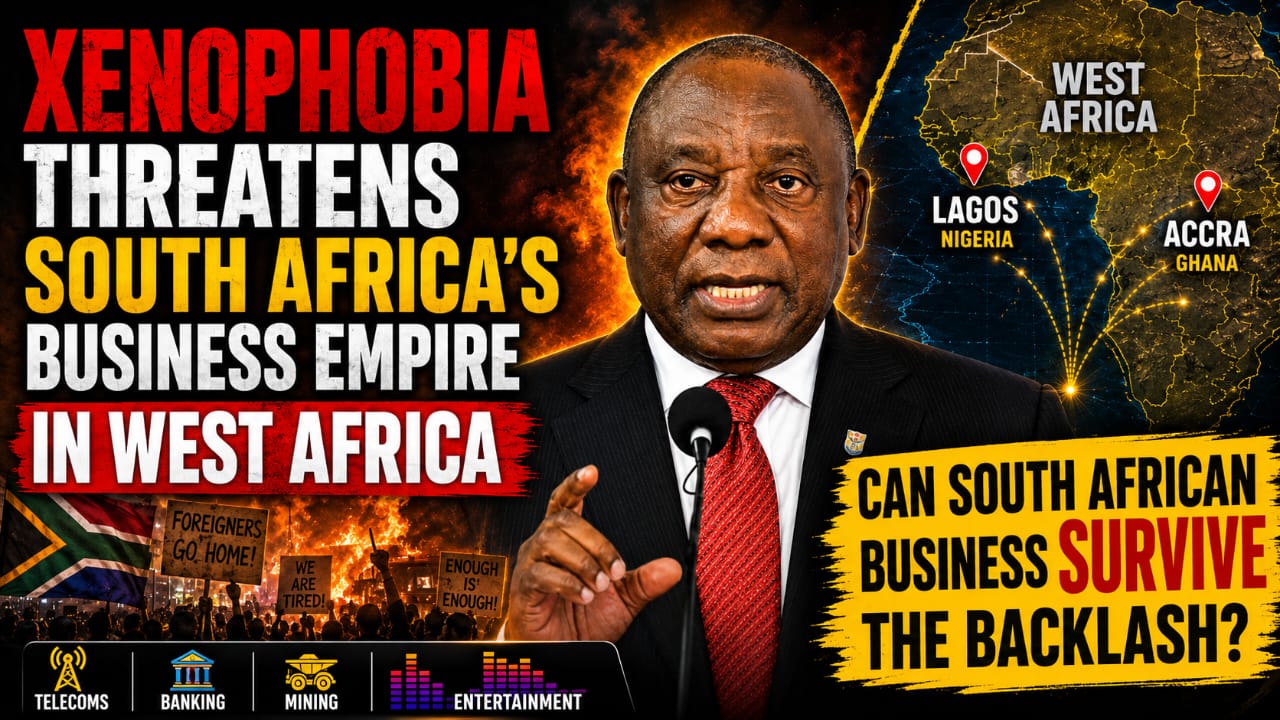
As African migrants flee hostility in South Africa, major companies in telecommunications, banking, mining and entertainment face growing reputational and commercial danger across the continent.
South African companies have spent decades building one of the most powerful corporate footprints in Africa.
Their telecommunications networks connect millions of people. Their banks finance businesses and households. Their mining companies control valuable assets, while their television and entertainment platforms reach homes across Nigeria, Ghana and much of West Africa.
But a new wave of anti-immigrant protests and xenophobic violence inside South Africa is exposing those companies to a danger they cannot easily contain.
The central question is becoming increasingly difficult to avoid:
Can South African businesses continue to prosper across Africa while African migrants are attacked, intimidated or made to feel unwelcome inside South Africa?
The answer may determine far more than the safety of a few corporate offices. It could affect consumer loyalty, diplomatic relations, government regulation, investment decisions and South Africa’s broader influence on the continent.
A domestic crisis crosses national borders
Anti-immigrant groups in South Africa have accused undocumented foreigners of taking jobs, contributing to crime and placing pressure on schools, hospitals and other public services.
These grievances are unfolding against a bleak economic background.
South Africa is struggling with severe unemployment, inequality, crime, poor public services and widespread frustration with political leadership.
Migrants, particularly those from other African countries, have repeatedly become convenient targets for anger generated by these deeper structural problems.
Recent protests and attacks have caused thousands of foreign nationals to seek assistance to leave South Africa or to shelter in temporary camps.
Nigerians, Ghanaians, Malawians, Mozambicans, Zimbabweans and other African nationals have reported fear, intimidation and violence.
Some of those affected have lived in South Africa for many years, raised families there and built businesses or careers within local communities.
Others have valid immigration documents but say that legal status provides little protection when mobs or vigilante groups decide who belongs and who does not.
South African President Cyril Ramaphosa has condemned the violence and warned citizens against taking immigration enforcement into their own hands.
His government has promised stronger border controls, more deportations of undocumented migrants and action against employers who knowingly hire people without legal status.
But Ramaphosa has also insisted that only the state has the authority to enforce immigration law.
That distinction is crucial.
A government may lawfully control its borders and remove people who have no legal right to remain. Private groups, however, have no right to assault migrants, seize property, invade homes or force people from communities.
West Africa begins to react
The crisis is increasingly becoming a diplomatic problem for Pretoria.
Nigeria, Ghana and other African governments have faced pressure to protect their citizens and demand accountability from South Africa.
Nigeria has assisted citizens who requested voluntary repatriation.
Ghana has raised the treatment of its nationals and called for stronger continental attention to the crisis.
The result is a growing perception that South Africa benefits enormously from African markets while failing to protect Africans living within its own borders.
That perception could become commercially explosive.
South African companies are highly visible throughout West Africa. Their brands appear on office buildings, shops, bank branches, mobile phones, television decoders and major infrastructure projects.
When anger against South Africa rises, those companies can become unofficial symbols of the country itself.
Their branches and service centres may be thousands of kilometres from Johannesburg or Pretoria, but in moments of diplomatic tension, the corporate logo can function like a national flag.
MTN sits at the centre of the storm
Few companies illustrate South Africa’s continental reach more clearly than MTN.
The telecommunications group operates across several African markets, with Nigeria representing one of its most important businesses.
MTN is also deeply established in Ghana and elsewhere on the continent.
Its services are woven into everyday life through mobile calls, internet access, digital payments and business communications.
That success, however, creates exposure.
Public anger against South Africa can quickly become anger against MTN, even though the company employs thousands of local workers, pays local taxes and has local shareholders.
The company has sought to present itself as a pan-African business rather than simply a South African corporation.
Its leadership has warned that retaliatory attacks or boycotts against African businesses would threaten jobs, investment, digital transformation and continental integration.
That argument is economically persuasive.
But it may not be enough to protect the brand if xenophobic violence continues.
In a crisis, consumers do not always distinguish between a country, its government and the companies associated with it.
MTN’s greatest danger may therefore be reputational rather than physical.
If the company is seen as silent, detached or insufficiently forceful in condemning attacks on Africans, the damage could spread far beyond South Africa.
Banking and financial interests under pressure
South African banking groups also have significant interests across West Africa.
Standard Bank operates in Nigeria through Stanbic IBTC and in Ghana through Stanbic Bank Ghana.
These businesses serve individuals, corporations, investors and governments.
They are deeply connected to local economies and employ local professionals.
Yet their South African identity can become politically sensitive when relations between Pretoria and West African capitals deteriorate.
A banking backlash would not necessarily take the form of smashed windows or street protests.
It could emerge through closer regulatory scrutiny, political pressure, lost government contracts, reduced consumer confidence or greater demands for local ownership.
Financial institutions rely heavily on trust.
Once a bank becomes entangled in a wider national-reputation crisis, repairing that trust can be costly.
Mining interests face a different kind of risk
The danger is equally serious in mining, though it may take a different form.
South African mining companies have substantial interests in countries such as Ghana.
Gold Fields, for example, has long operated important mining assets in Ghana, including the Tarkwa mine.
Mining companies depend on government licences, community relationships, security arrangements and public acceptance.
They therefore cannot afford prolonged diplomatic hostility between their home country and the country in which they operate.
Public anger over xenophobia could strengthen demands for stricter local-content rules, higher national participation, closer examination of mining leases and greater community benefits.
Those debates may already exist independently of the migrant crisis.
But xenophobic violence can give them new political force.
A government facing public outrage may find it harder to defend favourable treatment for a company identified strongly with South Africa.
Entertainment companies are equally exposed
MultiChoice and DStv are among the most visible South African-linked brands in West Africa.
Their products enter millions of homes and have helped shape television, sport and entertainment consumption across the continent.
But visibility is a double-edged sword.
The more familiar the brand, the easier it is for protesters or campaigners to identify it as a target.
Entertainment companies may face subscription boycotts, public criticism, regulatory pressure or calls for stronger local alternatives.
They may also find themselves dragged into a debate that has little to do with their actual business operations.
This is the wider danger for South African companies.
They can become targets not because of what they have done in Nigeria or Ghana, but because of what is happening in South Africa.
The warning from 2019
This is not a theoretical possibility.
During the 2019 xenophobia crisis, anger in Nigeria led to protests against South African-linked businesses.
MTN and Shoprite temporarily closed some outlets because of security concerns.
The Nigerian government appealed for calm and warned citizens not to attack companies employing Nigerians.
The episode demonstrated how quickly domestic violence in South Africa could produce economic consequences elsewhere.
It also revealed an uncomfortable truth.
When a South African-linked business is attacked in Nigeria, the first people affected may be Nigerian workers, suppliers, customers and franchise operators.
The same would be true in Ghana or other West African countries.
A branch office may carry a South African name, but the people working inside it are often local citizens.
Retaliation would punish the wrong people
The anger generated by xenophobic attacks is understandable.
African citizens should not be assaulted or driven from their homes simply because they crossed a border.
South Africa cannot expect to enjoy unlimited commercial goodwill across Africa while migrants from those same countries fear for their lives.
But retaliation against companies would create another form of collective punishment.
Attacking an MTN office, Stanbic branch or DStv service centre would not necessarily punish political leaders in Pretoria.
It might instead cost a Nigerian or Ghanaian worker a job.
A boycott could hurt local suppliers and shareholders.
Destroyed infrastructure could interrupt services relied upon by ordinary consumers and businesses.
Mob retaliation would also reproduce the very injustice it claims to oppose: punishing people because of nationality or association.
West African governments therefore face a delicate responsibility.
They must respond firmly and protect their citizens without encouraging violence against businesses.
Diplomatic protests, legal claims, stronger regulation and demands for corporate accountability are legitimate instruments.
Mob attacks are not.
South Africa’s national brand is deteriorating
South Africa’s Justice Minister has acknowledged that the country’s international image is being damaged.
That damage has consequences beyond tourism or diplomacy.
A country’s reputation follows its companies abroad.
For years, South African corporations have marketed themselves as continental champions.
They have presented their expansion as evidence of African entrepreneurship, African investment and African integration.
But pan-African commerce cannot be separated indefinitely from pan-African responsibility.
If companies earn most of their income outside South Africa, they must understand the political and moral expectations that come with that dependence.
They may increasingly be expected to speak publicly against xenophobia, support affected communities and use their influence within South Africa to oppose vigilante violence.
Corporations cannot solve the migration crisis.
But silence may become commercially expensive.
The greatest threat may not be broken windows
Physical attacks are only one possible consequence.
The more serious danger could be the slow erosion of goodwill.
Consumers may move to competing services.
Governments may impose tougher rules.
Mining licences may receive greater scrutiny.
Local-content requirements may become more demanding.
South African companies may face higher security and insurance costs.
Political leaders may become reluctant to award contracts to firms associated with a country seen as hostile to fellow Africans.
Competitors may seize the opportunity to present themselves as more genuinely local or pan-African.
This is how xenophobia travels.
It moves not only through violence but through diplomacy, regulation, investment decisions and consumer behaviour.
The contradiction at the heart of African integration
The crisis exposes a wider contradiction in Africa’s integration project.
The African Continental Free Trade Area seeks to encourage the movement of goods, services and investment across national borders.
Yet economic integration will remain incomplete if African people are treated as threats whenever they cross those same borders.
Capital cannot be welcomed while people are rejected.
Markets cannot be integrated while societies retreat into hostility.
African unity cannot exist only in summit declarations, corporate expansion plans or speeches by political leaders.
It must also be visible in the treatment of ordinary Africans seeking work, safety and opportunity.
South Africa has the right to control immigration.
It has the right to secure its borders.
It has the right to remove people who have no lawful permission to remain.
But it must do so through state institutions, due process and respect for human dignity.
Economic frustration cannot become a licence for vigilante violence.
A warning to Pretoria and corporate South Africa
South African businesses are now discovering that xenophobia is more than a humanitarian crisis.
It is a commercial risk.
The companies that carried South African influence across the continent may become the pressure points through which other African countries express their anger.
Pretoria must therefore recognise that protecting migrants is also part of protecting South Africa’s economic interests.
Corporate leaders must recognise that their continental success gives them both influence and responsibility.
And West African governments must ensure that legitimate anger does not become another campaign of collective punishment.
The task is not to destroy African businesses.
It is to protect African people.
South Africa’s companies have become deeply woven into the economic life of the continent.
The question is whether South Africa’s domestic politics will begin to unravel that achievement.
Can a country remain one of Africa’s leading commercial powers while repeatedly alienating the African societies on which that power depends?
The flames of xenophobia do not stop at the border.
They follow the flag.
They follow the brand.
And eventually, they may follow the money.