
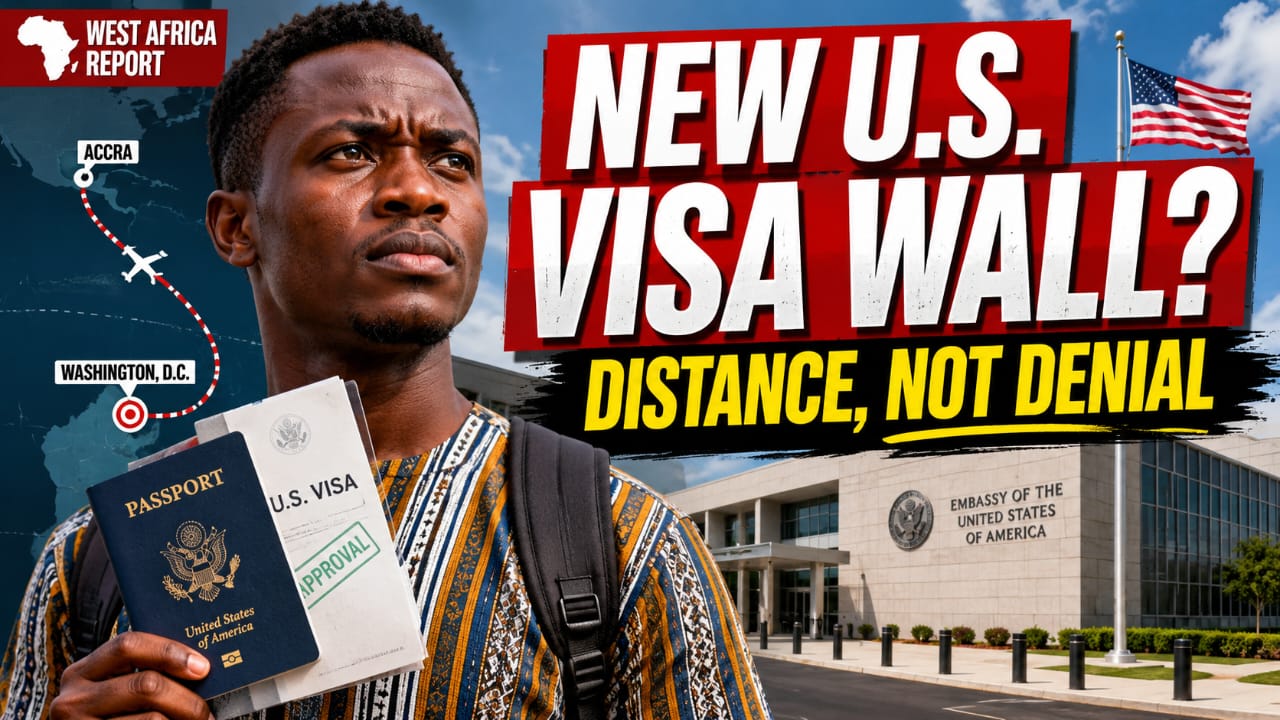
A planned consolidation of United States visa services across Africa could force applicants to cross borders, spend more money and travel considerably farther merely to attend an interview.
The United States is reportedly preparing to reduce sharply the number of its embassies and consulates in Africa authorised to process visa applications.
Under the proposed arrangement, the existing network of almost 50 visa-processing posts would be consolidated into only 20 regional hubs.
The change would not necessarily mean the closure of every affected American embassy. Nor would it amount to an outright ban on African applicants.
But for many people across the continent, the practical effect could be the creation of a new barrier to America — one measured not primarily by rejection, but by distance.
An additional journey before the journey
An applicant living in a country without a designated processing hub may have to travel to another African country merely to attend a visa interview.
That could mean paying for an international flight or a lengthy road journey, securing accommodation, obtaining permission to enter the host country and spending additional days away from work, school or family.
All these expenses would arise before the applicant knows whether the American visa will be approved.
Students admitted to universities in the United States could be particularly affected. So could businesspeople attending conferences, researchers, artists, journalists, medical travellers and families hoping to visit relatives.
For wealthier applicants and large corporations, the additional cost may be manageable. For students, young professionals, small-business owners and families of modest means, it could become a decisive obstacle.
The new visa wall may therefore be built not from official denial, but from the price of reaching the interview counter.
West African cities become regional gateways
Several West African cities are reportedly among the locations selected to retain comprehensive visa-processing services.
They include Lagos, Accra, Abidjan, Dakar, Lomé, Monrovia and Praia.
These cities could consequently become more important gateways for applicants travelling from neighbouring countries.
But concentrating applications in fewer centres also raises another question: can the selected hubs manage the additional demand without creating longer queues, crowded appointment calendars and greater processing delays?
An administrative policy intended to improve efficiency could instead transfer much of its burden to applicants.
Efficiency or exclusion by inconvenience?
The United States argues that its visa policies must protect national security, strengthen applicant screening and reduce visa overstays.
From Washington’s perspective, concentrating trained personnel and technical resources in fewer locations may offer administrative advantages.
The experience of African applicants, however, may be very different.
A system can remain formally open while becoming substantially harder to reach. Applicants may still possess the right to submit their documents, but exercising that right could require significantly more money, time and travel.
This is exclusion by inconvenience rather than prohibition.
It allows the door to remain officially open while moving it farther away.
More than an immigration story
Visa offices are not merely administrative counters. They are important points of contact between countries and the people hoping to study, trade, visit, collaborate or build relationships across borders.
The experience of obtaining a visa often shapes how applicants perceive the country they hope to enter.
If access becomes more expensive and geographically remote, the policy could influence wider African perceptions of the United States.
This comes at a time when global powers are competing for influence across Africa.
China continues to expand its commercial and infrastructural presence. Gulf countries are strengthening investment and aviation links. European governments are attempting to redefine their relationships with the continent.
The United States, meanwhile, remains a major destination for African students, professionals, entrepreneurs and families.
But a country cannot rely solely on the attraction of its universities, economy and institutions. The practical accessibility of those opportunities also matters.
Embassies may remain open
It is important to distinguish between reducing visa-processing services and closing diplomatic missions completely.
Embassies and consulates outside the designated hubs may continue providing services to American citizens, handling diplomatic and emergency cases and performing other diplomatic functions.
The major change concerns their capacity to process immigrant and non-immigrant visa applications for people seeking entry into the United States.
Applicants should therefore consult official information from the relevant U.S. embassy before making appointments or travel arrangements, as the precise implementation timetable and country-by-country procedures may vary.
Distance as policy
The planned consolidation raises a fundamental question about modern immigration control.
Does a government need to refuse applicants directly when it can make the application process more difficult, expensive and remote?
For many Africans, the first test may no longer be persuading a consular officer that they qualify for a visa.
It may be finding the money and time required to reach that officer.
The American visa door may remain open.
But for millions of potential applicants, the road leading to it could soon become considerably longer.