
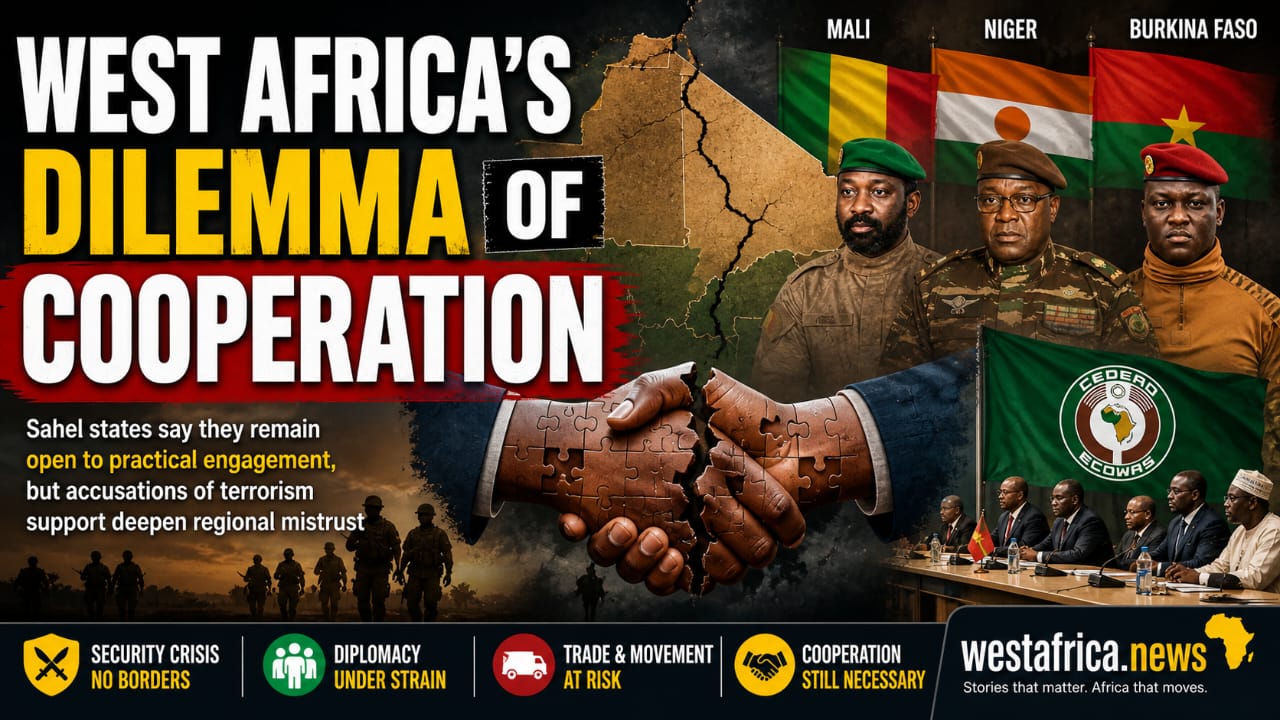
Sahel states say they remain open to practical engagement, but accusations of terrorism support deepen regional mistrust
Even as the Alliance of Sahel States insists that it wants to maintain practical cooperation with neighbouring countries after leaving ECOWAS, tensions across West Africa remain acute.
At a security forum in Senegal, the foreign ministers of Mali and Niger accused neighbouring states and external actors of supporting or harbouring terrorist groups, even while presenting themselves as open to continued engagement on trade, movement and regional coordination. The accusations, reported by Reuters, underline the difficult state of regional diplomacy at a time when West Africa urgently needs cooperation to confront insecurity across the Sahel.
The Alliance of Sahel States, made up of Mali, Niger and Burkina Faso, formally withdrew from ECOWAS after a period of worsening disagreement with the regional bloc. All three countries are currently ruled by military governments and have accused ECOWAS, France and other external powers of acting against their national interests. ECOWAS, on the other hand, has continued to urge dialogue and has tried to preserve some practical arrangements affecting citizens, trade and movement across borders.
This is the heart of West Africa’s present dilemma. The region’s security crisis does not respect borders. Armed groups move across frontiers, trading networks depend on cross-border movement, and millions of ordinary people rely on the old habit of regional exchange for food, livestock, transport and livelihoods. Yet political mistrust is now widening at precisely the moment when coordinated action is most needed.
The Sahel countries say their break with ECOWAS is political and institutional, not necessarily a total rejection of practical cooperation. Mali, Niger and Burkina Faso have argued that they must be free to define their own security and diplomatic priorities. But their departure has complicated the old machinery through which West African states managed mobility, trade, border policy and regional security.
The strain is already being felt beyond official diplomacy. Regional trade has continued, but it has become more difficult and uncertain in some areas, with traders facing new risks, informal routes and fears linked to insecurity and border controls. One recent report by PRNigeria noted that cross-border commerce has not collapsed, but has been reshaped by the political break between the AES countries and ECOWAS.
Security remains the most urgent concern. Mali, Niger and Burkina Faso have all faced persistent jihadist violence, while neighbouring states worry about the spread of instability toward coastal West Africa. In Mali, recent coordinated attacks by militants and separatist forces have again shown how fragile the security environment remains. The Associated Press reported that major assaults in late April targeted several areas, including Bamako and northern towns such as Kidal and Gao.
For ECOWAS, the challenge is delicate. A hard line may deepen the split. A soft line may appear to reward military takeovers and weaken the bloc’s authority. For the AES countries, the challenge is just as difficult. They want distance from ECOWAS politically, but geography still binds them to the rest of West Africa. Their economies, borders, communities and security problems remain tied to the same regional space.
That is why the language of cooperation continues to survive, even amid accusation and suspicion. Mali and Niger may reject a return to ECOWAS, but they still signal interest in limited cooperation on matters that affect daily life and national survival. ECOWAS may be frustrated by the Sahel breakaway, but it cannot easily ignore the fact that West Africa’s security architecture is weaker without the participation of the central Sahel.
The danger now is that West Africa may drift into a two-track reality: one in which countries continue to speak of cooperation, while mistrust makes serious coordination almost impossible. That would be costly for border communities, traders, transporters, security agencies and ordinary citizens caught between politics and necessity.
For the Sahel and its neighbours, diplomacy remains open — but strained. The region needs working channels on intelligence, border control, humanitarian access, trade routes and movement of people. Without those channels, West Africa risks allowing political division to worsen a security crisis that already demands collective action.
The contradiction is therefore stark. West Africa needs cooperation more urgently than ever. Yet the politics of trust, legitimacy and sovereignty are pulling its governments further apart.
For now, the door to diplomacy is not closed. But it is no longer wide open either.