Launched at the 25th Nigeria International Book Fair in Lagos, a new multi-volume anthology argues that Africa’s sustainability future must be shaped not only by global targets and technical policy, but by books, culture, knowledge, memory and lived African experience.
At the Wole Soyinka Centre for Culture and Creative Arts in Lagos, the building formerly known to generations of Nigerians as the National Theatre, an ambitious new publishing project has placed African voices at the centre of one of the defining conversations of the age: how societies can live, learn and develop sustainably.
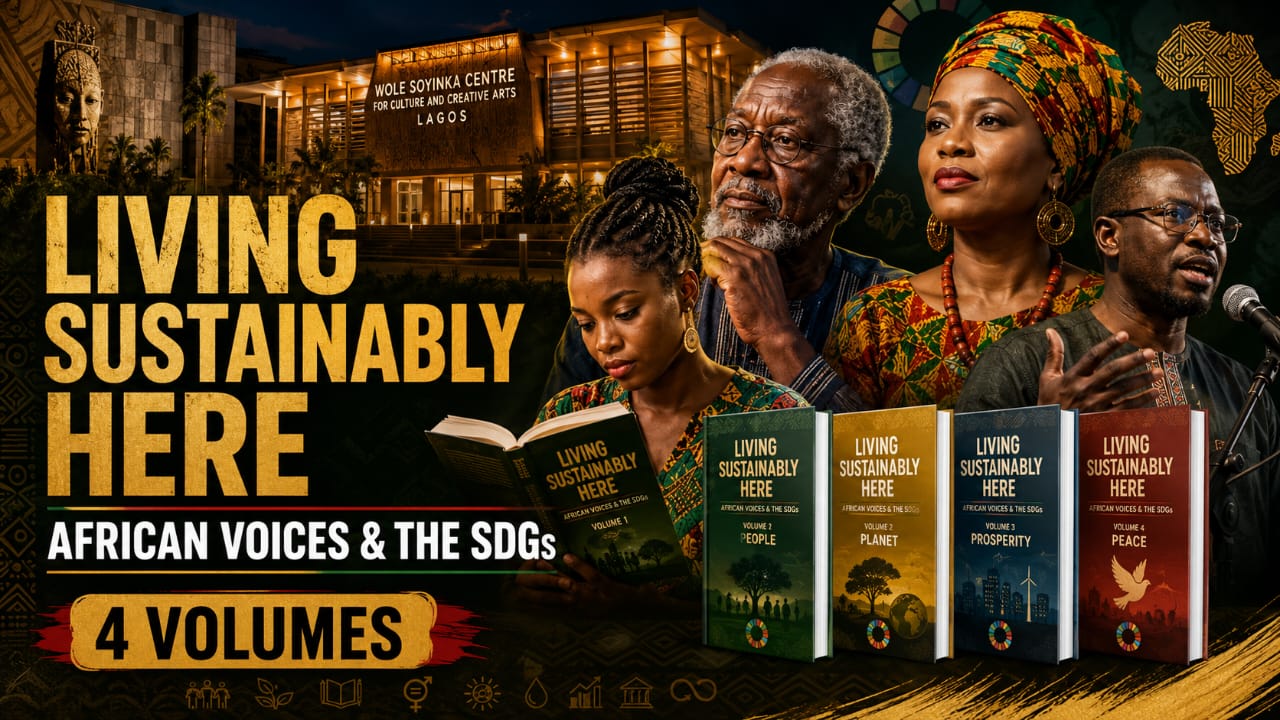
Living Sustainably Here: African Perspectives on the SDGs, published by Selina Publishers, was presented during the 25th Nigeria International Book Fair, held in Lagos from May 13 to 15, 2026. Event information made available to WestAfrica.News indicates that four volumes of the anthology were launched as part of the fair.
The setting was significant. The Nigeria International Book Fair, celebrating its 25th edition, brought publishers, writers, librarians, educators, booksellers, institutions and readers together at a time when questions about education, access to knowledge and the future of African publishing are becoming increasingly urgent. The International Publishers Association listed the anniversary edition at the Wole Soyinka Centre, while the Book Fair’s 2026 programme was organised around the theme, Education for All.
But the launch of Living Sustainably Here was more than another publishing event on a busy literary calendar. It represented an effort to move the United Nations Sustainable Development Goals, often discussed through institutional targets and policy documents, into the texture of African life itself.
The anthology brings together African voices, lived realities and knowledge traditions to consider sustainability through literature, education, social transformation, indigenous knowledge, digital culture, energy, justice and human development. Its official project platform describes it as a multi-volume body of work positioned at the meeting point of literature, education, sustainable development and African knowledge systems.
Living Sustainably Here
At the heart of the project is a simple but forceful proposition: Africa must not remain merely the subject of global development debates. Africans must be among the strongest voices defining what sustainability means, what it requires and how it can be achieved.
Taking Sustainability Out of Conference Language
Speaking at the Lagos event, the project’s founder and editor, Olatoun Gabi-Williams, described the anthology as an attempt to bring the vocabulary of sustainable development closer to the everyday realities of African communities.
“This project has a simple but important mission: to translate the global language of sustainable development into lived African experience,” she said during the conference and preview of the anthology.
That idea provides the intellectual backbone of Living Sustainably Here.
For many people across Africa, sustainability is not primarily a phrase encountered in international reports. It is experienced in the availability or absence of schools and books; in whether a community has access to electricity; in whether young people can acquire useful knowledge; in the survival of indigenous languages and cultural memory; in climate pressures, unemployment, insecurity and the search for justice.
The anthology attempts to capture these intersections through essays and reflections that do not separate culture from development or knowledge from survival.
Gabi-Williams has argued that knowledge must itself be understood as infrastructure. Speaking at the Lagos gathering, she said publishing, books, learning and cultural production were not decorative additions to development, but essential foundations of it.
“Knowledge is huge. It cuts across the arts, cognition and human development. It is infrastructure in itself,” she said.
Books, Libraries and the Architecture of Development
The opening volume, Paths to Knowledge: Production, Access, Literacy and Sustainable Development, begins from the argument that no society can develop sustainably while large numbers of its people remain excluded from books, libraries, schools and the means of producing knowledge.
According to material supplied on the anthology, the volume follows the many routes through which knowledge is created, shared and sustained in African societies: formal education, informal learning, schools, libraries, publishing and cultural practice.
That argument resonated strongly at the Book Fair conference, where participants discussed the condition of libraries, the cost and availability of books, the challenges facing publishers and booksellers, and the decline — or changing character — of reading habits in Nigeria.
One discussion examined how bookstores might become more than retail outlets, growing into active community spaces where readers and creative people meet. Another considered the role of parents in building reading habits at home, particularly in an age when screens and phones increasingly compete with books for the attention of children.
The conference also raised uncomfortable but necessary questions about the Nigerian education system: whether schools are simply preparing students to pass examinations, whether frequently changing textbook requirements are adding avoidable pressure on families, and whether certain educational models are preparing young Africans to contribute to their societies or merely to leave them.
These questions go well beyond the book industry. They concern the type of society Africa intends to build.
A nation that cannot place books in the hands of its children, sustain libraries in its communities or value the production of ideas will struggle to fulfil even the most ambitious development agenda.
Technology Without Losing Memory
The second volume, Our Digital Lives and Indigenous Pathways, widens the conversation into technology, ancestry, storytelling and cultural memory.
Africa is becoming increasingly digital. Mobile phones, social platforms, online publishing, artificial intelligence, digital classrooms and virtual communities are changing how people learn, communicate, create and remember.
But the volume raises a deeper question: will Africa’s digital future preserve the continent’s knowledge traditions, or simply sweep them aside?
The essays explore routes towards sustainability that are both modern and ancestral: digital platforms and remembered practices; publishing and storytelling; cooking, teaching and filmmaking; innovation and cultural inheritance.
This is particularly relevant at a time when digital technologies increasingly determine which voices are heard and which forms of knowledge are preserved. The debate around open educational resources, digital archives and artificial intelligence is not only about access. It is also about ownership, cultural protection and who has the power to frame African knowledge for future generations.
At the Lagos conference, contributors and participants examined the importance of protecting African and indigenous knowledge from extraction and misuse, even while expanding access to learning and research.
That tension — between openness and ownership, technology and tradition, innovation and memory — is likely to become one of the central cultural questions of Africa’s digital age.
An Africa Already Under Pressure
The third documented volume, Africa Under Pressure: Literature, Energy, Equity, Justice and Security, moves the anthology into some of the continent’s most immediate struggles.
It gathers voices confronting energy insecurity, inequality, conflict, social responsibility, freedom, justice, science, education and the growing pressures borne by African communities.
The volume’s central insight is that sustainability cannot be discussed only in optimistic language. Across the continent, millions of people are already living at the fault lines of environmental stress, economic hardship, insecurity and unequal access to opportunity.
Yet the anthology does not present Africa as merely a landscape of crisis. Its essays also point towards imagination, resistance and renewal — towards the capacity of literature, education, public debate, science and social action to help societies respond to their hardest challenges.
In this sense, Living Sustainably Here is not asking Africans simply to accept development agendas devised elsewhere. It is inviting them to interrogate those agendas, contribute to them and remake them through African experiences and priorities.
Why the Venue Matters
The decision to launch the project at the Wole Soyinka Centre for Culture and Creative Arts carried considerable symbolism.
The iconic Lagos building, reconstructed and recommissioned in October 2025 after decades as the National Theatre, was renamed in honour of Nobel laureate Wole Soyinka, one of Africa’s most enduring literary voices. The centre has returned to public life not only as a performance venue but as a statement about the place of culture in Nigeria’s future.
There could hardly have been a more fitting setting for an anthology insisting that books, ideas and cultural expression belong within Africa’s development conversation.
The old National Theatre was built in the era of FESTAC ’77, when Nigeria sought to project the creative and intellectual confidence of Africa and its diaspora to the world. Nearly five decades later, the launch of Living Sustainably Here at the renewed cultural landmark offered a quieter but related assertion: Africa’s future must be imagined, argued and narrated by Africans themselves.
From Lagos to a Wider African Conversation
Although the project currently draws substantially from Nigerian experience, its ambition is continental. Gabi-Williams has indicated that the anthology is expected to expand its engagement across Africa and ultimately reach wider global audiences.
The project’s official website, unveiled during the Lagos event, provides a digital home for the developing anthology and presents it as a long-term platform for scholarship, reflection, public engagement and institutional dialogue.