
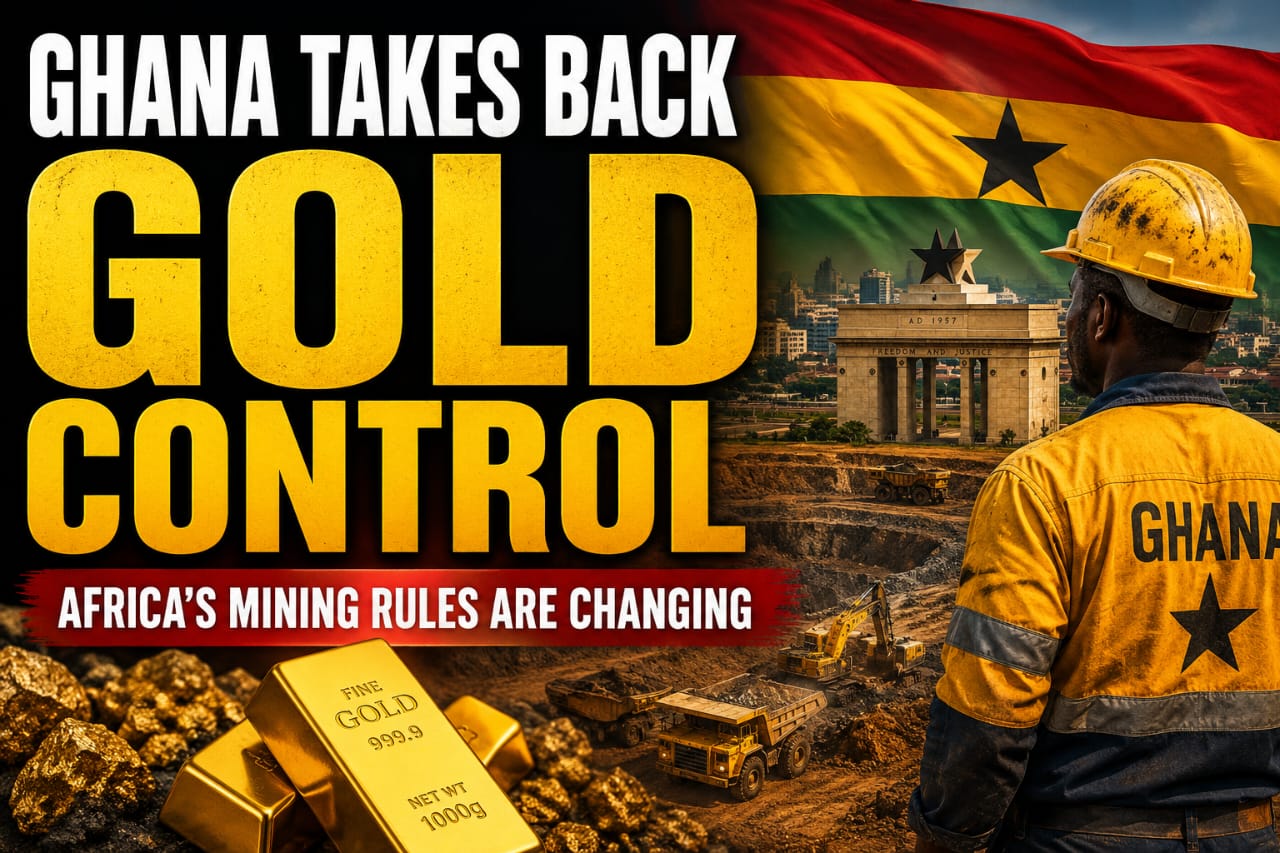
Ghana is sending a clear message to the global mining industry: the old rules can no longer be taken for granted.
For decades, many African countries welcomed foreign mining companies under arrangements designed to attract investment, technology and international capital. But the deeper question has always remained unresolved: how much real value stays at home?
Now, Accra appears to be pushing that question back to the centre of national policy.
The issue is not simply whether foreign companies should mine gold in Ghana. The more important question is whether mining rights, lease renewals and control of mineral assets should continue almost automatically, or whether the state must use those moments to renegotiate power, ownership and national benefit.
Ghana’s handling of mining leases, including the Damang gold mine issue involving Gold Fields, has become a major signal of this changing mood. The Ghanaian government previously declined to automatically renew the Damang lease, a move widely read as a break from the old pattern of routine extensions. A transitional arrangement was later reached, but the message had already landed: mining companies can no longer assume that yesterday’s access guarantees tomorrow’s control.
This is happening at a time when Ghana is also tightening control over the broader gold value chain. In 2025, Ghana moved to restrict foreign involvement in the trading and purchasing of artisanally mined gold, giving the newly established Ghana Gold Board a central role in buying, selling, assaying and exporting small-scale mined gold.
The aim is to increase oversight, improve state revenue and retain more value from gold exports.
For Ghana, Africa’s leading gold producer, this is more than a mining dispute. It is a sovereignty question.
Gold has long been one of the great symbols of African wealth. Yet across the continent, mineral-rich countries have often struggled to translate underground abundance into broad public prosperity. Mines may operate for decades, but local communities still complain about poverty, environmental damage, weak infrastructure and limited participation in the higher-value parts of the industry.
That contradiction is now becoming harder to defend.
Accra’s new posture reflects a wider African mood. From gold to lithium, cobalt, oil and gas, governments are increasingly asking whether natural resources should merely be exported, or whether they should become instruments of industrial development, local ownership and long-term economic transformation.
There is, of course, a delicate balance to strike. Mining remains a capital-intensive business. Foreign investors argue that uncertainty around leases and regulations can discourage investment, reduce confidence and delay future projects. Ghana’s Chamber of Mines has already warned that uncertainty over lease renewals and policy direction could affect the country’s attractiveness as a mining destination.
That concern cannot simply be dismissed. African governments need investment, expertise and operational capacity.
But investors also need to understand that the political economy of African mining is changing.
The old bargain — extract, export, repatriate profit, and renew — is under pressure.
What Ghana appears to be saying is that mining must now serve a larger national purpose. Lease renewals should not be treated as a formality. Local participation must deepen. Gold trading must be better regulated. And the country must capture more value from the resource that has shaped its economy for generations.
This does not mean Ghana is closing the door to foreign mining companies. Rather, it suggests that the door will now open on tougher terms.
For Africa, the real prize is not simply gold in the ground. It is the power to decide how that gold is mined, who benefits from it, and how much of its value remains at home.
The message from Accra is unmistakable: the age of automatic renewals and foreign-dominated mineral control is being challenged.
And if Ghana succeeds in turning this policy shift into genuine value retention, local capacity and stronger public benefit, its example may travel far beyond its own borders.
Africa’s mining rules are changing. Ghana has simply made the warning impossible to ignore.
WestAfrica.news will continue to follow how African countries are redefining ownership, value and sovereignty in the global resource economy.