
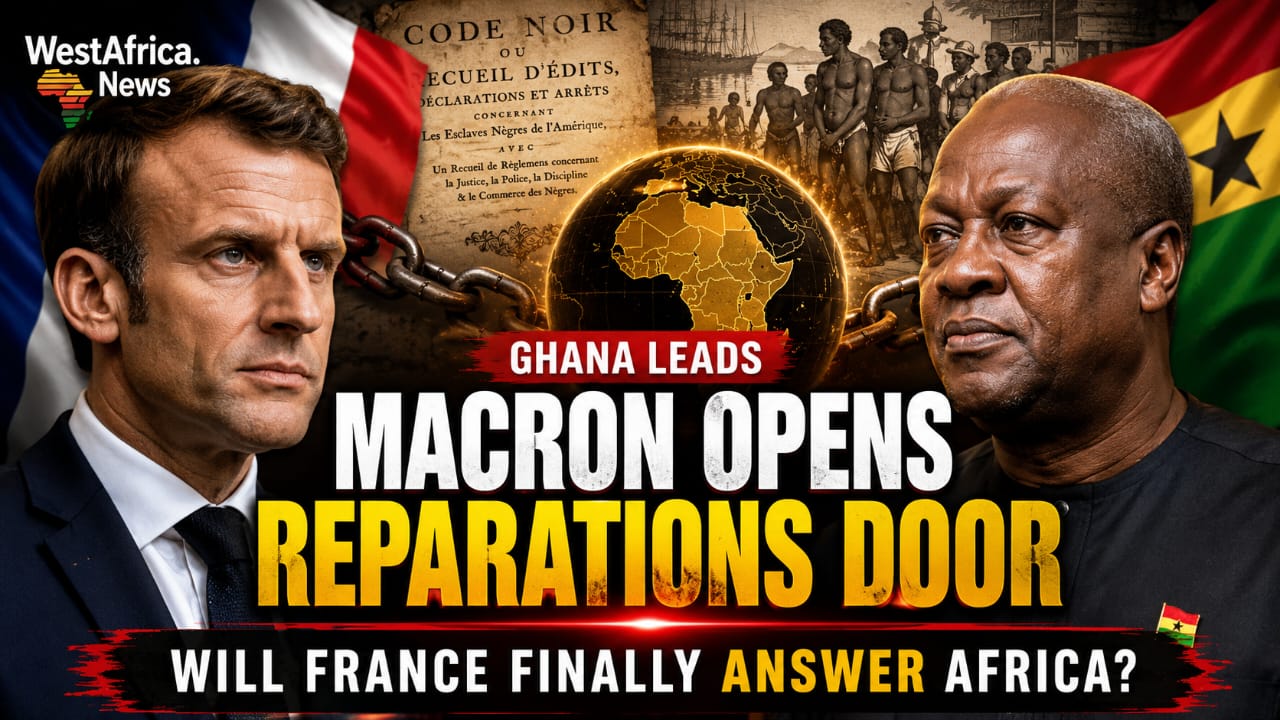
France has opened a new conversation on reparations for slavery, but the harder question remains: will symbolic recognition lead to material justice?
French President Emmanuel Macron has stepped into one of the most difficult historical debates linking Europe, Africa and the Caribbean: the question of reparations for slavery.
In a recent speech marking the 25th anniversary of France’s 2001 law recognising slavery and the slave trade as crimes against humanity, Macron acknowledged that France must address the issue of reparations connected to its role in the transatlantic slave trade.
It was a significant political moment. For years, France has preferred the language of memory, recognition and education. Reparations, especially in any material or financial sense, remained a much more sensitive subject.
Macron did not announce a compensation programme. He did not present a financial package. He did not commit France to direct payments to descendants of enslaved Africans or to states affected by the slave trade. But by using the language of reparations and backing further research and policy work, he moved the subject from the margins of public debate closer to the centre of French political discussion.
That shift matters.
France was deeply involved in the transatlantic slave trade and colonial plantation economy. Its Caribbean territories, its former colonies and its economic history are all bound to a system that extracted labour, wealth and human lives from Africans on a vast scale.
For many campaigners, recognition alone is no longer enough. They argue that slavery was not only a moral catastrophe of the past, but also a system whose consequences continue in inequality, racial discrimination, land dispossession, cultural loss and the underdevelopment of communities shaped by colonial extraction.
This is why the debate has grown beyond France.
At the United Nations, a major resolution recently declared the transatlantic slave trade one of the gravest crimes against humanity. The resolution, strongly backed by African and Caribbean voices, was supported by a large majority of countries. But several Western nations abstained, including France.
That abstention became politically uncomfortable. It suggested that while France was willing to speak about memory and recognition, it remained cautious about international legal and political steps that could strengthen claims for reparatory justice.
Africa has also become more organised on the issue. The African Union has placed reparations firmly on the continental agenda, with Ghana playing a leading role in global advocacy. For many African and diaspora leaders, reparations are not simply about money. They are about truth, public memory, institutional accountability, cultural restitution, education, development support and a rebalancing of historical narratives.
The debate also comes as France moves to confront one of the darkest documents in its legal history: the Code Noir.
The Code Noir, first issued under King Louis XIV in the 17th century, regulated slavery in French colonies and treated enslaved Africans as property. Although France abolished slavery in 1848, the Code Noir was never formally removed from French law until lawmakers moved to repeal it symbolically.
The National Assembly’s vote to repeal the Code Noir was historic, but it also exposed the limits of symbolic action. The legislation acknowledged historical wrong, but did not include direct reparations.
For some, that is ap necessary first step. For others, it is another example of Europe recognising injustice without paying the real cost of repair.
That is where the debate now stands.
Macron’s language has changed. France is beginning to speak more openly about the moral weight of slavery. The Code Noir is being pushed out of the shadows of legal history. Research commissions and public memory projects are being proposed.
But the central question remains unresolved.
What should reparations mean?
Should they mean financial payments? Debt relief? Investment in affected communities? Scholarships? Museums and memorials? Return of cultural property? Formal apologies? Development funds? Or a combination of all these?
For Africa and the diaspora, the answer may not be one thing. The deeper demand is for the world to stop treating slavery as a closed chapter and begin recognising it as a foundational event in the making of modern global inequality.
Macron has not settled the reparations question. But by speaking the word more openly, he has helped push the debate into a new phase.
France may want to manage the conversation carefully. Africa and the diaspora may want it to move faster.
Either way, the old silence is breaking.
And once the question of reparations enters the room, it rarely leaves quietly.