
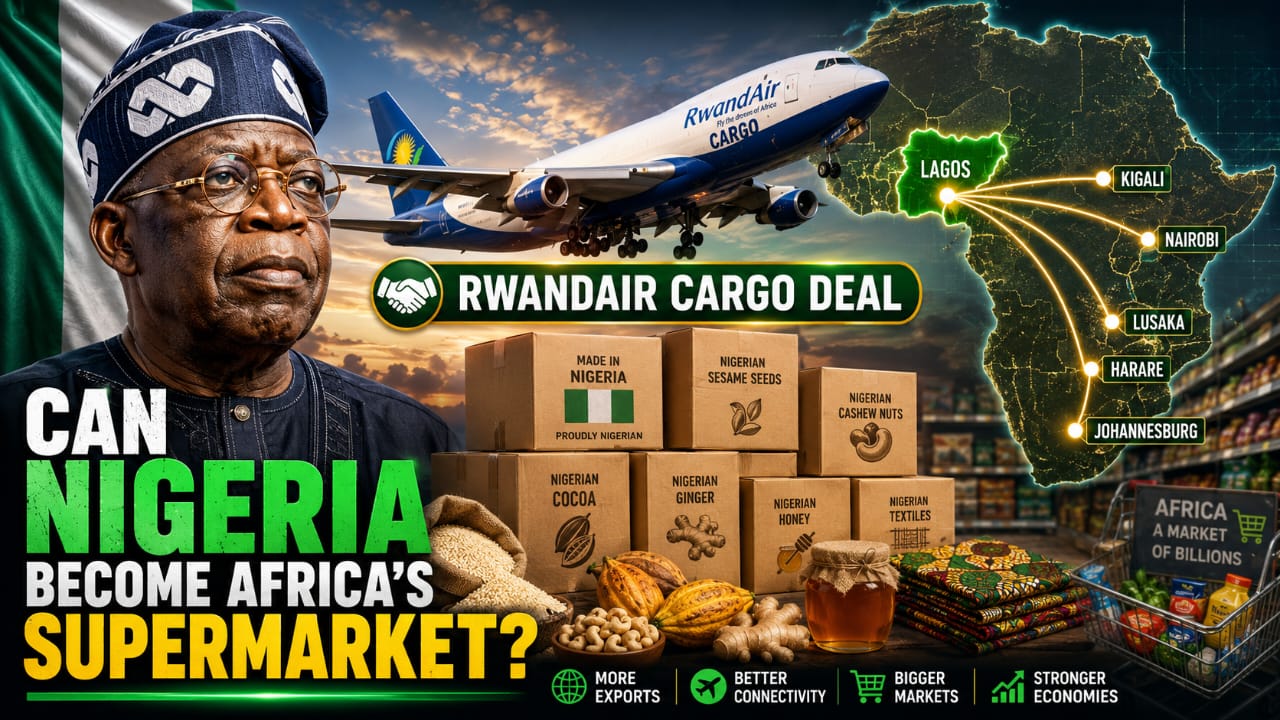
– RwandAir Cargo Deal Opens New Export Routes
A new Nigeria–RwandAir cargo partnership could lower export costs and give Nigerian businesses wider access to East and Southern African markets — but logistics remains the real test.
Nigeria is trying to turn African trade from political slogan into practical movement of goods.
The Federal Government’s new cargo partnership with RwandAir has opened a fresh conversation about Nigerian exports, African connectivity and the real meaning of the African Continental Free Trade Area.
Under the arrangement, cargo rates on selected RwandAir routes are expected to fall below $2 per kilogramme across five destinations. That is a major shift from previous costs that reportedly ranged between $3 and $10 per kilogramme for exporters trying to move goods into East and Southern African markets.
For Nigerian businesses, especially small and medium-sized exporters, that difference could be important.
The new corridor is expected to strengthen cargo movement from Lagos to Kigali, Harare, Lusaka, Nairobi and Johannesburg. Kigali, Harare and Lusaka are being added as new destinations, while Nairobi and Johannesburg will gain another carrier option for Nigerian exporters.
On paper, the opportunity is clear.
Nigeria has goods that can travel: processed foods, cosmetics, fashion, textiles, agricultural products, packaged consumer goods and light manufactured items. Many of these products already have demand within African communities. The problem has often been cost, access, documentation, logistics and reliability.
If cargo becomes cheaper and routes become more predictable, Nigerian producers may finally find it easier to place their goods on shelves across Africa.
That is why the story is bigger than aviation.
This is not only about RwandAir. It is about whether Nigeria can use transport partnerships to become a stronger supplier to African markets. It is also about whether AfCFTA can move from summit speeches and signed documents into real business activity.
For years, African leaders have spoken about intra-African trade. But African businesses often find it easier to import from Asia, Europe or the Middle East than to trade efficiently with neighbouring or regional African markets. High freight costs, weak transport links, customs delays and poor information have all limited the movement of goods within the continent.
The Nigeria–RwandAir partnership is therefore a practical test.
Can lower air cargo rates help Nigerian exporters compete? Can small businesses in Lagos, Aba, Kano, Ogun, Onitsha, Ibadan and other production centres actually access this corridor? Can goods reach the airport on time? Can exporters handle documentation and customs requirements without being discouraged? Can African destination markets absorb more Nigerian products?
These are the questions that will determine whether the deal becomes a headline or a turning point.
There is also a strategic question.
Some Nigerians may ask why RwandAir is carrying part of Nigeria’s export ambition. That question is understandable. Nigeria is Africa’s largest economy by population and one of its most important markets. Many would expect it to have a stronger national cargo aviation system of its own.
But the other argument is just as important: African integration will not happen if every country waits to build everything alone. If RwandAir has capacity and Nigeria has exporters, then cooperation may be exactly what AfCFTA requires.
The goal should not be national pride alone. The goal should be movement — of goods, services, businesses and value across African borders.
For Nigerian SMEs, this corridor could be especially important. Large exporters usually have more options. Smaller producers often struggle with freight costs, market information and distribution. If the cargo system is made accessible, affordable and simple enough, it could help more Nigerian-made products enter African supermarkets, boutiques, pharmacies, food stores and distribution networks.
That is where the phrase becomes powerful: can Nigeria become Africa’s supermarket?
It is not a boast. It is a question.
Nigeria has the population, creativity, entrepreneurial energy and product diversity. But production alone is not enough. Goods must move. Prices must make sense. Quality must be consistent. Packaging must meet standards. Routes must be reliable. Customs systems must support trade rather than frustrate it.
The RwandAir deal offers a promising opening. It could reduce one of the biggest barriers facing exporters: the cost of getting goods from Nigeria into other African markets quickly.
But cheaper cargo will not solve everything.
Nigeria still needs better inland logistics, stronger export support systems, clearer documentation channels, more reliable production clusters, improved product standards and aggressive market intelligence across Africa.
If those pieces come together, this cargo corridor could become more than a transport arrangement. It could become a small but important step toward reshaping how Africa trades with itself.
For now, the opportunity is real.
The test is execution.
Can Nigeria use cheaper air cargo to turn local products into continental brands?
That is the bigger story behind the RwandAir deal.