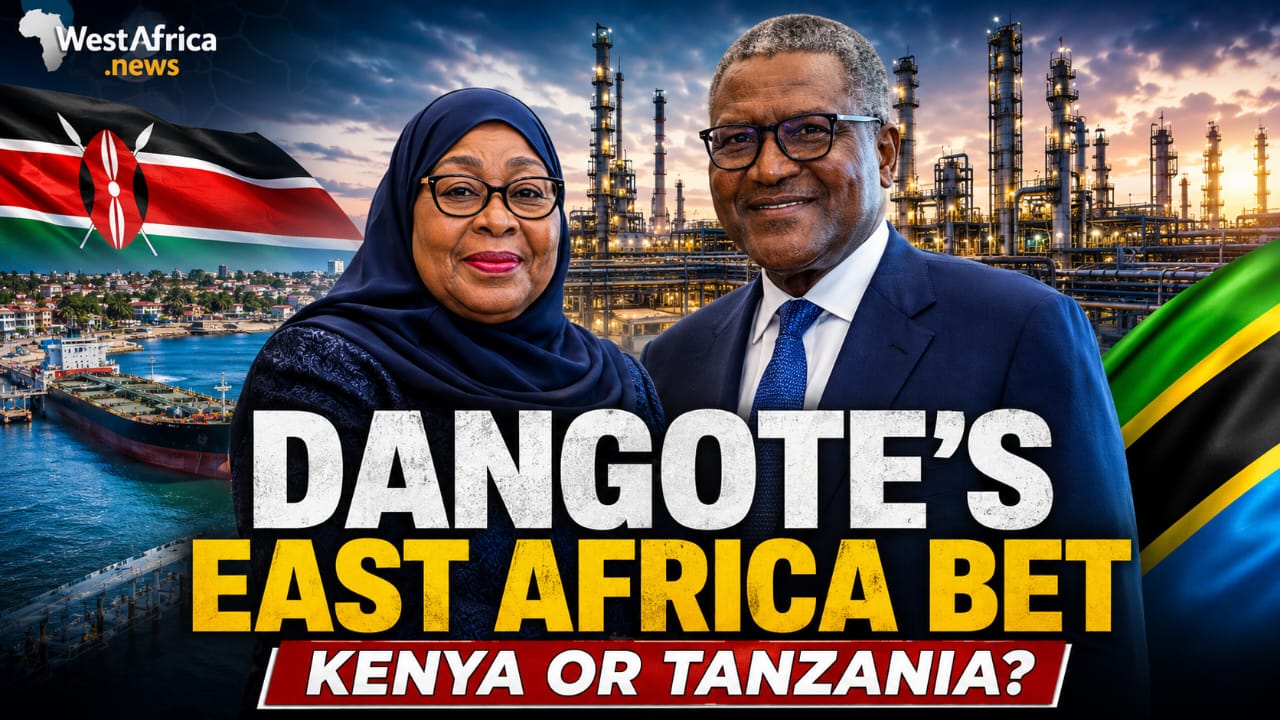
With Aliko Dangote reportedly favouring Kenya’s Mombasa after an earlier regional proposal centred on Tanzania’s Tanga port, a proposed mega refinery has become a contest over ports, fuel security, industrial ambition and East Africa’s economic future.
For a region that imports virtually all its refined petroleum products, the question of where East Africa’s next major refinery may be built is about far more than geography.
It is about fuel prices, supply security, port power, regional influence and the larger African ambition to process more of what the continent consumes within the continent itself.
At the centre of the unfolding story is Aliko Dangote, the Nigerian industrialist whose 650,000-barrel-per-day refinery in Lagos has already transformed discussions about African-scale refining. Now, Dangote is considering a second project of similar capacity in East Africa — and two coastal cities, Tanga in Tanzania and Mombasa in Kenya, have emerged at the heart of the contest.
The proposal has already stirred strong reactions across the region, particularly among Kenyans and Tanzanians, for whom the refinery is no longer simply an investment opportunity. It has become a matter of national pride and strategic positioning.
The project first pointed towards Tanzania
The refinery story entered public view on April 23, 2026, when Kenyan President William Ruto said East African countries were discussing a joint refinery project at Tanzania’s port of Tanga.
The proposal was ambitious: a regional plant capable of processing crude from countries including Uganda, South Sudan, Kenya and the Democratic Republic of Congo, while supplying refined fuel to a much wider East African market.
Dangote, speaking at the same infrastructure financing conference in Nairobi, said he was willing to lead the development of a new East African refinery if participating governments gave the necessary backing. He suggested that, once agreements were reached, the project could be built within four to five years.
Tanga appeared, at first, to offer an attractive strategic position. Tanzania is already central to East Africa’s emerging petroleum infrastructure through the East African Crude Oil Pipeline project, which is designed to carry Ugandan crude to the Tanzanian coast.
A refinery in Tanga could therefore have strengthened Tanzania’s position as an energy corridor linking inland oil producers to the Indian Ocean and the wider global market.
But the early announcement also raised a politically sensitive question: how firmly had Tanzania itself been consulted before the idea was publicly presented?
Then Mombasa emerged as Dangote’s preferred option
The story shifted sharply in May.
In an interview reported by the Financial Times on May 9, 2026, Dangote said he was leaning towards Mombasa, Kenya, rather than Tanzania’s Tanga port, as the site of the proposed refinery.
The facility under consideration would process about 650,000 barrels of crude oil per day, roughly matching the capacity of Dangote’s Lagos refinery. Its estimated construction cost is between $15 billion and $17 billion.
Dangote’s reasoning appeared commercial and practical.
Mombasa has a larger and deeper port, capable of accommodating major shipping and industrial operations. Kenya also has a larger domestic economy and a higher fuel consumption base than Tanzania. For a refinery requiring enormous capital expenditure and a large, reliable market, these factors could carry decisive weight.
Reuters reported on May 10, 2026 that Dangote had identified Mombasa’s port advantages and Kenya’s fuel demand as key attractions, while stressing that the final direction of the project would depend on the support of President William Ruto and the Kenyan government.
That support could involve land, infrastructure, regulatory guarantees, financing arrangements and policies governing refined fuel imports.
For Kenya, landing a project of this scale would be a historic industrial achievement.
Mombasa is already a major maritime and fuel gateway for East Africa. A large refinery on the Kenyan coast could strengthen supply routes into Uganda, Rwanda, Burundi, South Sudan and parts of the Democratic Republic of Congo, while positioning Kenya at the centre of a new regional petroleum economy.
Tanzania is still in the race
Yet Tanzania has not simply stepped aside.
On May 16, 2026, President Samia Suluhu Hassan met Dangote at State House in Dar es Salaam. Tanzania’s official presidential communications confirmed the meeting, publishing images of the president with the Dangote Group founder and chairman.
Reporting in Tanzania subsequently said the discussion involved a proposed regional partnership for the multibillion-dollar refinery project, with Tanzania and other East African countries potentially participating in a facility serving the wider region.
The meeting was significant because it demonstrated that Tanzania remains interested in the investment and that Tanga cannot yet be dismissed as an option.
For President Samia, the project represents more than a contest with Kenya. Tanzania has strategic grounds for wanting the refinery: its port ambitions, its location on the planned route for Ugandan crude oil, and its desire to become a stronger energy and industrial gateway for East and Central Africa.
For Dangote, however, the location will ultimately have to satisfy a brutal commercial equation: where can crude be delivered most efficiently, products distributed most profitably and government support secured most reliably?
Why a refinery matters so much to East Africa
East Africa currently relies heavily on imported refined petroleum products, much of it sourced from outside the continent. This leaves the region vulnerable whenever international shipping is disrupted, crude and refined fuel prices rise, or foreign exchange shortages increase import costs.
Fuel disruption is never limited to petrol stations.
It quickly affects transport fares, airline costs, food distribution, manufacturing, household spending, trade routes and public finances.
A regional refinery of the size being discussed could therefore have enormous economic implications. It could create industrial and construction jobs, encourage new pipelines and storage infrastructure, support regional supply chains and reduce the region’s exposure to imported refined fuel.
It could also become one of Africa’s strongest symbols of industrial self-reliance: African capital, working with African governments, to produce a strategic commodity for African markets.
That ambition is one reason Dangote’s Lagos refinery looms so large over the East African discussion.
Built at vast cost and after years of difficulty, the Lagos facility has begun producing fuel for Nigerian and export markets. Reuters reported in April 2026 that the refinery had increased exports of gasoline and urea fertiliser into African markets as regional supply pressures intensified.
The message is powerful: a large African refinery can alter trade patterns and create new possibilities for regional supply.
But the Nigerian experience also provides a warning.
Building the refinery is only the beginning
Large refineries require more than concrete, steel and engineering expertise.
They depend on political stability, predictable regulation, reliable access to crude oil, efficient ports, pipelines and storage facilities, and a market system in which locally refined products are not undermined by inconsistent policy or uncontrolled cheap imports.
Dangote has already made clear that government support will be central to any East African project.
This means the competition between Mombasa and Tanga is not merely a beauty contest between two ports. It is a test of which government, or group of governments, can provide the strongest long-term commercial framework.
Would Kenya offer Dangote a secure location, regulatory certainty and access to regional markets?
Would Tanzania’s proximity to emerging crude export infrastructure make Tanga a more logical refining location?
Could the project be structured as a genuinely regional enterprise, with several East African governments participating through equity or guaranteed market arrangements?
Or will national competition make regional cooperation more difficult?
These questions remain unanswered.
Kenya versus Tanzania — or East Africa together?
The public debate has understandably taken on a competitive tone.
For many Kenyans, Mombasa represents the stronger commercial case: an established maritime gateway, a larger market and an opportunity for Kenya to lead a major new phase of East African industrialisation.
For many Tanzanians, Tanga represents a project whose strategic logic was already recognised: a coastal hub connected to the emerging flow of regional crude and capable of strengthening Tanzania’s role in East Africa’s energy future.
Both arguments carry weight.
But the deeper issue may be whether East Africa can afford to see the refinery only through the lens of national victory or national defeat.
A refinery processing 650,000 barrels per day would almost certainly require a market larger than one country. Its commercial success would depend on regional demand, cross-border infrastructure and cooperation between states whose consumers all need reliable fuel.
Whether the plant is eventually built in Kenya or Tanzania, its real significance would lie in its ability to serve a region currently dependent on imported refined products.
No final decision yet
Despite the excitement and the regional debate, no final location for the refinery has been publicly confirmed.
Dangote has expressed a preference for Mombasa. Tanzania has held direct talks with him. Kenya has obvious commercial advantages. Tanga still has strategic significance.
The project remains at the stage where diplomacy, economics, policy and negotiation will determine whether the idea becomes reality — and where it will eventually stand.
What is already clear, however, is that East qAfrica has recognised the importance of refining its own future.
The contest between Mombasa and Tanga reflects something larger than rivalry between Kenya and Tanzania. It reflects a continent increasingly impatient with exporting opportunity, importing vulnerability and leaving its most important industrial decisions to distant markets.
¹For East Africa, the real prize is not simply hosting a refinery.
It is gaining greater command over the fuel that moves its people, powers its economies and shapes its future.¹
And for Africa, the Dangote refinery saga raises an even bigger question:
Can the continent finally turn industrial ambition into regional power?