
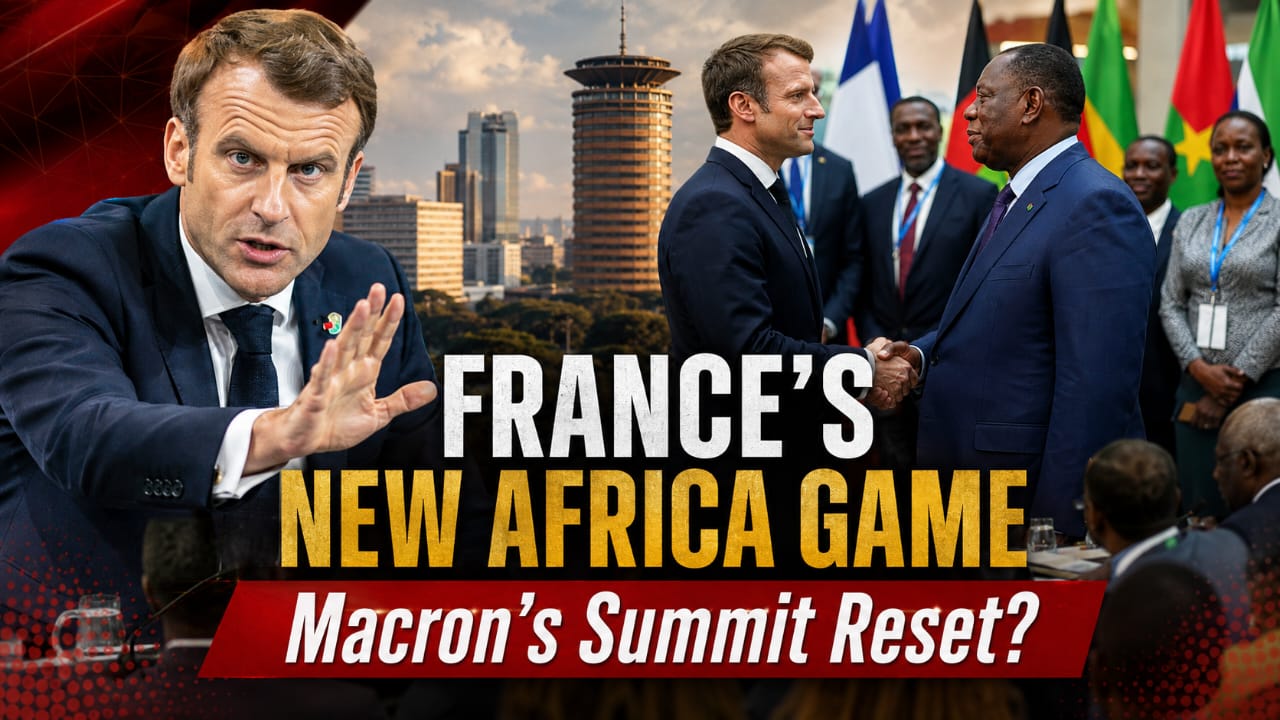
France is not leaving Africa.
It is changing its method.
That may be the clearest message from the recent Africa Forward Summit in Nairobi, Kenya, where French President Emmanuel Macron and Kenyan President William Ruto co-hosted a major gathering of African leaders, investors, business figures and young innovators.
Officially, the summit was framed as “Africa–France Partnerships for Innovation and Growth.” It was held in Nairobi on 11–12 May 2026, and its location was itself a statement: France had taken a major Africa summit into an English-speaking country, far beyond its old Francophone comfort zone.
For decades, France’s African policy was closely tied to its former colonies in West and Central Africa. That relationship produced political influence, military presence, currency debates, cultural ties and business networks — but also deep suspicion. Critics gave it a name: Françafrique.
Now, that old map is under strain.
In recent years, France has suffered serious diplomatic and military setbacks across parts of the Sahel. In countries such as Mali, Burkina Faso and Niger, anti-French sentiment has grown, while other global players have moved into spaces France once occupied more comfortably. That is why the Nairobi summit was not merely a conference. It was a signal that Paris is searching for a new road into Africa’s future.
The new language is investment.
At the summit, Macron announced about €23 billion, roughly $27 billion, in investment commitments for Africa. The figure includes public and private funding, with attention on sectors such as energy, artificial intelligence, industry, agriculture, health and infrastructure.
That figure matters. But the more important story is the posture behind it.
France is trying to move from the image of a former colonial power with soldiers, bases and old political networks, to the image of a modern partner offering capital, technology, industrial cooperation and access to global finance.
This is a major shift in tone.
Instead of speaking mainly through defence agreements and diplomatic habits inherited from the past, France is now speaking the language of innovation, green energy, ports, digital technology, business partnerships and youth entrepreneurship.
But Africa is also changing.
The continent is no longer waiting for one foreign partner to define its future. China, Turkey, the Gulf states, India, the United States, Russia and others are all competing for influence, markets, minerals, technology corridors, ports and diplomatic partnerships.
This new reality gives African governments more room to bargain.
Kenya’s role in the summit underlines that point. President Ruto has repeatedly pushed the argument that Africa does not need charity as much as it needs fairer investment terms, better risk ratings, lower borrowing costs and a reformed global financial system.
Reuters reported that African leaders used the Nairobi gathering to push for a rethink of how risk is priced on the continent, arguing that current assumptions make capital too expensive for African development.
That argument goes to the heart of Africa’s new diplomatic posture.
The continent is not simply asking who wants to help. It is asking who is ready to invest on fair terms.
Still, the Nairobi summit also showed why France’s reset will not be easy.
Macron faced criticism after interrupting a public session at the University of Nairobi to rebuke members of the audience for making noise while speakers were on stage. Some people applauded him for defending the speakers. Others saw the moment as uncomfortable and patronising — precisely the kind of behaviour France’s new language of partnership is supposed to leave behind.
That moment may become one of the most memorable images of the summit.
It captured France’s dilemma in Africa: the words have changed, the stage has changed, the investment promises have changed — but many Africans are still watching closely to see whether the attitude has truly changed.
For France, Nairobi was an attempt to say: we understand the old formula no longer works.
For Africa, the reply may be: partnership is welcome, but not hierarchy.
The summit therefore marks an important moment, not because it settles the future of France–Africa relations, but because it exposes the new terms of engagement.
France is no longer operating in an Africa where old loyalties can be assumed.
Africa is more assertive, more courted, more strategic and more aware of its value in a changing world economy.
#WestAfricaNews #AfricaFranceSummit #AfricaForwardSummit #FranceAfricaRelations #Macron #WilliamRuto #Kenya #Nairobi #Francafrique #AfricaInvestment #AfricanPolitics #AfricaEconomy #Sahel #GlobalSouth #AfricanDiplomacy #FranceInAfrica #AfricaRising #NewsRecap