
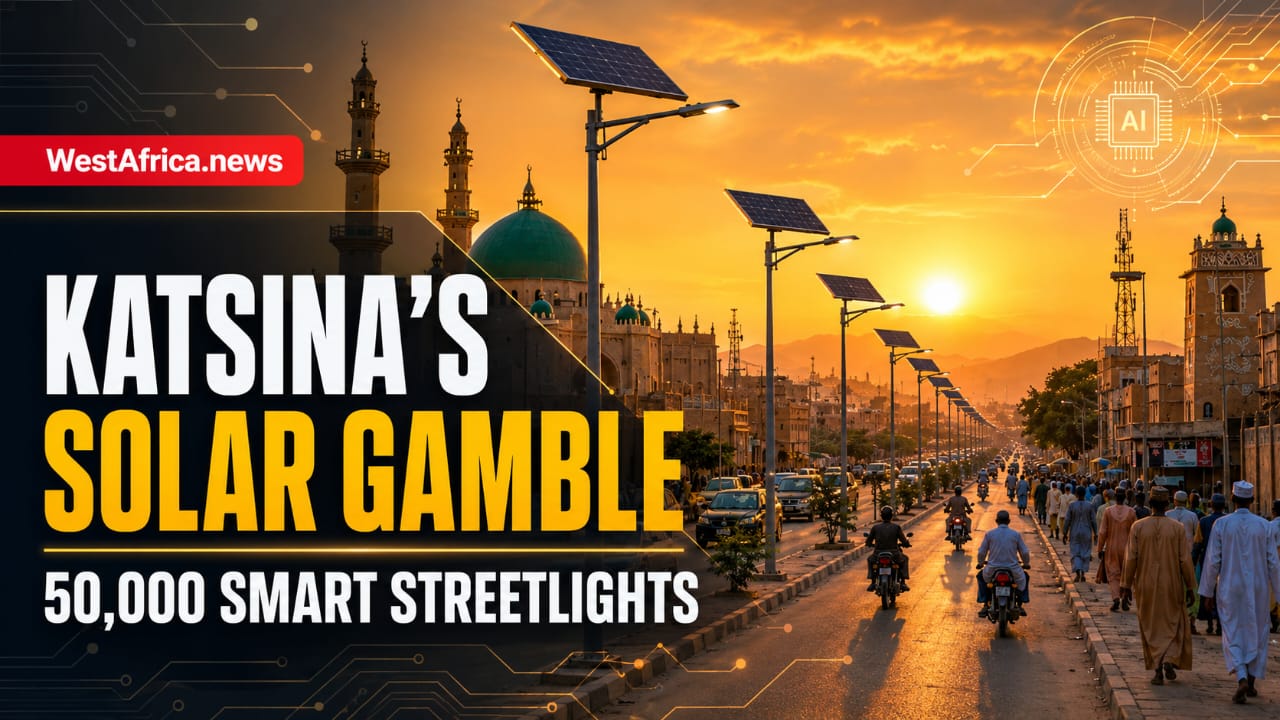
Katsina State is moving into unusual territory in Nigeria’s energy and technology space after signing a deal for the deployment of 50,000 solar-powered smart streetlights across the state.
The project, involving UK-based Conflow Power Group Limited and its Nigerian partner, Mora Energy, is being presented as more than a public lighting programme. The solar-powered units, known as iLamps, are designed to provide street lighting while also supporting public WiFi, Bluetooth connectivity, monitoring systems and distributed AI computing capacity.
For a state in northern Nigeria, where power access, public safety and infrastructure gaps remain major development challenges, the significance of the project goes beyond technology branding. If implemented successfully, it could show how off-grid solar systems can serve multiple public functions at once: lighting roads, improving connectivity, supporting digital infrastructure and reducing dependence on Nigeria’s unstable national grid.
Nigeria’s electricity problem remains one of the country’s biggest obstacles to industrial growth and everyday economic life. Millions of citizens and businesses still operate with unreliable electricity, forcing households, schools, hospitals, farms and small enterprises to depend heavily on generators, fuel and private alternatives.
This is why solar projects, mini-grids and state-led power initiatives are becoming more important. Across Nigeria, governments and private investors are increasingly looking beyond the central grid, which has struggled with repeated failures, transmission weaknesses, gas supply problems and years of underinvestment.
The Katsina project is therefore arriving at a moment when decentralised energy is no longer a side story. It is becoming part of Nigeria’s survival strategy.
According to reports on the agreement, each iLamp will be powered by solar energy and will operate without drawing electricity from the national grid. The promoters say the system will also avoid the heavy water and electricity demands associated with conventional large-scale data centres.
Conflow’s chief executive, Edward Fitzpatrick, has described the Katsina deployment as a new model for AI infrastructure, with computing capacity distributed across thousands of solar-powered streetlight units rather than concentrated in one large facility.
This is where the story becomes both exciting and sensitive.
On the positive side, the project could help Katsina tackle street lighting deficits, support public internet access and create a platform for smart infrastructure. In a region where insecurity has affected movement, farming, trade and community life, better lighting and monitored public spaces may be seen by many residents as a welcome development.
Street lighting can matter in very practical ways. It can improve night-time visibility, support transport, assist traders and reduce the sense of exposure in public spaces. If public WiFi and connectivity are added, the impact could extend into education, commerce, communication and emergency response.
But there are also important questions.
Any system that includes AI-enabled cameras, monitoring or data collection must be governed carefully. Public safety technology can easily become controversial if citizens are not clear about who controls the data, how long it is stored, whether surveillance is being used, and what protections exist against abuse.
This is especially important because smart infrastructure is not only about equipment. It is also about trust. The public must know whether such systems are being used for safety, service delivery and development — or whether they could become tools of unchecked surveillance.
For Katsina, the challenge will be implementation.
Nigeria has seen many ambitious infrastructure announcements that later slowed down, changed shape or failed to deliver at the promised scale. The real test will not be the signing ceremony, but whether the 50,000 units are actually deployed, maintained and integrated into public life in a transparent and accountable way.
Maintenance will be critical. Solar panels, batteries, sensors, cameras, lighting units and communications systems require technical support. Insecurity, vandalism, harsh weather, poor procurement practices and weak after-sales maintenance can all undermine even the most promising public infrastructure.
There is also an economic question. If the system is described as revenue-generating because the streetlights can sell AI computing capacity, citizens will want to know how that revenue is shared, whether the state benefits directly, and whether local jobs, technical training and manufacturing will follow.
That point matters because Nigeria’s energy transition must not become another imported-technology story in which equipment arrives from abroad, while local capacity remains weak. For projects of this scale to create deeper value, they should support training, local maintenance, technical partnerships and possibly local assembly or manufacturing.
The project also fits into a wider national shift. Nigeria has been trying to expand solar manufacturing and renewable energy capacity. State governments, private investors and development agencies are increasingly exploring decentralised power systems, especially in places where the national grid remains unreliable or absent.
That makes Katsina part of a broader story: Nigerian states are beginning to think of power not simply as electricity from the main national grid, but as a local development tool.
Lagos is pursuing independent power arrangements. Rural areas are turning to mini-grids. Northern states are seeking solar solutions that can work across wide territories. Businesses are installing rooftop solar to escape diesel costs and grid failures. Schools, clinics, markets and small industries are increasingly being drawn into the conversation around off-grid and hybrid power.
Katsina’s new project adds an AI and smart infrastructure layer to that movement.
Still, the promise must be measured against the practical realities of Nigerian public infrastructure: procurement transparency, maintenance culture, security of installed assets, technical capacity, data protection and long-term financing.
If Katsina gets it right, the state could become an important test case for solar-powered public infrastructure in Africa. It would show that streetlights can be more than streetlights — that they can become nodes in a wider public system linking energy, safety, digital access and local development.